Question

The variation of anode current in a triode corresponding to a change in grid potential at three different values of the plate potential is shown in the diagram. The mutual conductance of the triode is

(a) 2.5 m mho

(b) 5.0 m mho

(c) 7.5 m mho

(d) 10.0 m mho

Answer

(a) 2.5 m mho

Need a full question paper?

Generate a complete, print-ready paper with questions like this in minutes — across 16+ boards, with answer keys.

Start Generating Free

Similar questions

Consider the situation of the previous problem. The directions of the magnetic field due to the dipole are opposite at:

The wavelength of light emitted from second orbit to first orbits in a hydrogen atom is

(a) 1.215  

(b) 1.215  

(c) 1.215  

(d) 1.215  

If radius of Bohr's first orbit is ' $r$ ' then radius of second orbit will be :

Two thin lenses whose powers are +2D and –4D respectively combine, then the power of combination is

(a) – 2D

(b) + 2D

(c) – 4D   

(d) + 4D

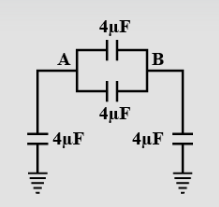
 Find equivalent capacitance between A and B

Which of the following helps us in the determination of the temperature of sun

(a) Kirchhoff's law

(b) Maxwell Boltzmann law

(c) Planck's law

(d) Stefan's law

A hank of uninsulated wire consisting of seven and a half turns is stretched between two nails hammered into a board to which the ends of the wire are fixed. The resistance of the circuit between the nails is determined with the help of electrical measuring instruments. Determine the proportion in which the resistance will change if the wire is unwound so that the ends remain to be fixed to the nails.
A semiconducting device is connected in a series circuit with a battery and a resistance. A current is found to pass through the circuit. If the polarity of the battery is reversed, the current drops to almost zero. the device may be:
  1. An intrinsic semiconductor.
  2. A p-type semiconductor.
  3. An n-type semiconductor.
  4. A p-n junction.

A hollow sphere of charge does not produce an electric field at any

(a) Point beyond 2 metres

(b) Point beyond 10 metres

(c) Interior point

(d) Outer point

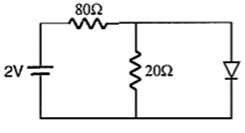
In the circuit shown, the current through the ideal diode is:
Image