MCQ
The vector equation r = i − 2j − k + t(6j − k) represents a straight line passing through the points:
  • A
    (0, 6, −1) and (1, −2, −1)
  • B
    (0, 6, −1) and (−1, −4, −2)
  • (1, −2, −1) and (1, 4, −2)
  • D
    (1, −2, −1) and (0, −6, 1)

Answer

Correct option: C.
(1, −2, −1) and (1, 4, −2)
Cartesian representation of the given line is,

$\frac{\text{x}-1}{0}=\frac{\text{y}+2}{6}=\frac{\text{z}+1}{-1}=\text{t}$

So any point on the given line is of the form (1, 6t − 2, − t − 1) where t can be any real numbers

So for t = 0 and 1 the corresponding points are (1, −2, −1) and (1, 4, −2)

You can check other options does not satisfy above point for any t.

Need a full question paper?

Generate a complete, print-ready paper with questions like this in minutes — across 16+ boards, with answer keys.

Start Generating Free

Similar questions

Let $N$ be the set of positive integers. For all $n \in N$, let $f_n=(n+1)^{1 / 3}-n^{1 / 3} \text { and }$ $A=\left\{n \in N: f_{n+1}<\frac{1}{3(n+1)^{2 / 3}} < f_n\right\}$ Then,
Let the area enclosed by the lines $x + y =2, y =0$, $x=0$ and the curve $f(x)=\min \left\{x^2+\frac{3}{4}, 1+[x]\right\}$ where $[ x ]$ denotes the greatest integer $\leq x$, be $A$. Then the value of $12\,A$ is $............$.
If $y = x:$
$\underset{n\to \infty }{\mathop{\lim }}\,\frac{{{1}^{99}}+{{2}^{99}}+{{3}^{99}}+......{{n}^{99}}}{{{n}^{100}}}=$
Choose the correct answer from the given four options.
$X$ $-4$ $-3$ $-2$ $-1$ $0$
$P(X)$ $0.1$ $0.2$ $0.3$ $0.2$ $0.2$
For the following probability distribution $E(X)$ is equal to :
If $a+\alpha=1, b+\beta=2$ and $\operatorname{af}(x)+\alpha f\left(\frac{1}{x}\right)=b x+\frac{\beta}{x}, x \neq 0,$ then the value of expression $\frac{ f ( x )+ f \left(\frac{1}{ x }\right)}{ x +\frac{1}{ x }}$ is ..... .
Differential equation of $y = A{e^{2x}} + B{e^{ - 2x}}$ is (Where $A$ and $B$ are arbitrary constants)
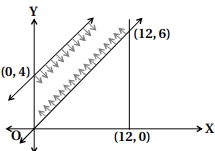
The feasible region for an $LPP$ is shown in the Figure. Let $z=3 x-4 y$ be the objective function. Maximum value of $z$ is $....$
If $\text{A}=\frac{1}{\pi}\begin{bmatrix}\sin^{-1}(\pi\text{x})&\tan^{-1}(\frac{\text{x}}{\pi})\\\sin^{-1}(\frac{\text{x}}{\pi})&\cot^{-1}(\pi\text{x})\end{bmatrix},$ $\text{B}=\frac{1}{\pi}\begin{bmatrix}-\cos^{-1}(\pi\text{x})&\tan^{-1}(\frac{\text{x}}{\pi})\\\sin^{-1}(\frac{\text{x}}{\pi})&-\tan^{-1}(\pi\text{x})\end{bmatrix},$ then A - B is equal to:
If $\frac{\text{dy}}{\text{dx}}=\frac{\text{x}+\text{y}}{\text{x}},\text{y}(1)=1,$ then $y =$