MCQ
The velocity of a particle performing simple harmonic motion, when it passes through its mean position is
  • A
    Infinity
  • B
    Zero
  • C
    Minimum
  • Maximum

Answer

Correct option: D.
Maximum
(d) In S.H.M. at mean position velocity is maximum So $v=a \omega$ (maximum)

Need a full question paper?

Generate a complete, print-ready paper with questions like this in minutes — across 16+ boards, with answer keys.
Start Generating Free

Similar questions

The relation between phase difference $(\Delta \phi)$ and path difference $(\Delta x)$ is
If the telescope is reversed i.e. seen from the objective side
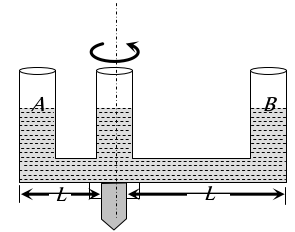
A given shaped glass tube having uniform cross section is filled with water and is mounted on a rotatable shaft as shown in figure. If the tube is rotated with a constant angular velocity $\omega$ then
Image
A coil of area $100 \mathrm{~cm}^2$ has $500$ turns. Magnetic field of $0.1$ weber / metre ${ }^2$ is perpendicular to the coil. The field is reduced to zero in $0.1$ second. The induced e.m.f. in the coil is
One mole of an ideal gas at an initial temperature of $T K$ does $6 R$ joules of work adiabatically. If the ratio of specific heats of this gas at constant pressure and at constant volume is $5 / 3$, the final temperature of gas will be
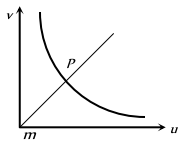
The graph shows variation of $v$ with change in $u$ for a mirror. Points plotted above the point $P$ on the curve are for values of $v$
Image
A mass $M$ is suspended from a spring of negligible mass. The spring is pulled a little and then released so that the mass executes simple harmonic oscillations with a time period $T$. If the mass is increased by $m$ then the time period becomes $\left(\frac{5}{4} T\right)$. The ratio of $\frac{m}{M}$ is
The period of revolution of planet $A$ around the sun is 8 times that of $B$. The distance of $A$ from the sun is how many times greater than that of $B$ from the sun
An inductance of $1 mH$ a condenser of $10 \mu F$ and a resistance of 50 $\Omega$ are connected in series. The reactances of inductor and condensers are same. The reactance of either of them will be
Two electric bulbs $A$ and $B$ are rated as $60\ W$ and $100\  W$. They are connected in parallel to the same source. Then,