MCQ
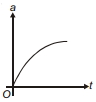
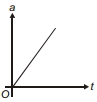
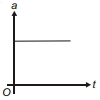
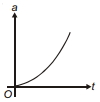
The velocity $v$ of a particle moving along $x$-axis varies with its position $(x)$ as $v=\alpha \sqrt{x}$; where $\alpha$ is a constant. Which of the following graph represents the variation of its acceleration (a) with time $(t)$ ?
  • A

  • B


  • D

Answer

Correct option: C.

c
(c)

$v=\alpha \sqrt{x}$

Squaring both sides $v^2=\alpha^2 x$

Comparing above equation with $3^{\text {rd }}$ equation of kinematics.

$v^2=u^2+2 a x$

$\alpha^2 x =2 a x$

$\Rightarrow a=\frac{\alpha^2}{2}$

$\,\downarrow$

$\text { Constant } \rightarrow \text { not a function of time }$

so,

Need a full question paper?

Generate a complete, print-ready paper with questions like this in minutes — across 16+ boards, with answer keys.
Start Generating Free

Similar questions

A sphere is rolled on a rough horizontal surface. It gradually slows down and stops. The force of friction tries to:
  1. Decrease the linear velocity.
  2. Increase the angular velocity.
  3. Increase the linear momentum.
  4. Decrease the angular velocity.
A block of mass m is placed on a smooth wedge of inclination 0. The whole system is accelerated horizontally so that the block does not slip on the wedge. The force exerted by the wedge on the block has a magnitude:
In SI system the fundamental units are
The length of second's hand in a watch is $1 \,cm.$ The change in velocity of its tip in $15\, seconds$ is
A cube has numerically equal volume and surface area. The volume of such a cube is  ........... $units$
An observer is approaching with a speed $v$, towards a stationary source emitting sound waves of wavelength $\lambda_0$. The wavelength shift detected by the observer is (Take $c=$ speed of sound)
One mole of a gas obeying the equation of state $P(V-b)=R T$ is made to expand from a state with coordinates $\left(P_{1}, V_{1}\right)$ to a state with $\left(P_{2}, V_{2}\right)$ along a process that is depicted by a straight line on a $P-V$ diagram. Then, the work done is given by
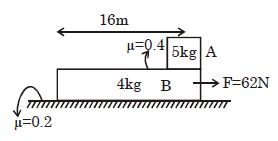
Initially the whole system is at rest and now a force of $62\ N$ is applied on the block $B$ as shown in the figure. Find the time taken by $'A'$ to fall from the block $'B'$ ........... $\sec$
For an ideal liquid
Two block of masses $10\,kg$ and $4\,kg$ are connected by a spring of negligible mass  and placed on a frictionless horizontal surface. An impulse gives a velocity of $14\, m/s$ to  the heavier block in the direction of the lighter block. The velocity of the centre of mass is ........ $m/s$.