The vertical extension in a light spring by a weight of $1\, kg$ suspended from the wire is $9.8\, cm$. The period of oscillation
Easy


Download our appand get started for free
Experience the future of education. Simply download our apps or reach out to us for more information. Let's shape the future of learning together!No signup needed.*
Similar Questions
- 1$x$ and $y$ displacements of a particle are given as $x(t) = a\,sin\,\omega t$ and $y(t) = a\,sin\,2\omega t.$ Its trajectory will look likeView Solution
- 2A small body of mass $0.10\, kg$ is executing $S.H.M.$ of amplitude $1.0 \,m$ and period $0.20\, sec$. The maximum force acting on it is.... $N$View Solution
- 3The periodic time of a body executing simple harmonic motion is $3\, sec$. After how much interval from time $t = 0$, its displacement will be half of its amplitude ..... $\sec$View Solution
- 4Two pendulum have time periods $T$ and $5T/4$. They start $SHM$ at the same time from the mean position. After how many oscillations of the smaller pendulum they will be again in the same phaseView Solution
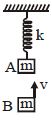
- 5Block $A$ is hanging from a vertical spring and it is at rest. Block $'B'$ strikes the block $'A'$ with velocity $v$ and stick to it. Then the velocity $v$ for which the spring just attains natural length is:View Solution
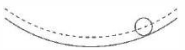
- 6A ball is rolling without slipping in a spherical shallow bowl (radius $R$ ) as shown in the figure and is executing simple harmonic motion. If the radius of the ball is doubled, then the time period of oscillationView Solution
- 7A loaded vertical spring executes $S.H.M.$ with a time period of $4\; sec$. The difference between the kinetic energy and potential energy of this system varies with a period of ........$sec$View Solution
- 8In a seconds pendulum, mass of bob is $30\, gm$. If it is replaced by $90\, gm$ mass. Then its time period will .... $\sec$View Solution
- 9A particle of mass m is executing oscillations about the origin on the $X-$axis. Its potential energy is $U(x) = k{[x]^3}$, where $k$ is a positive constant. If the amplitude of oscillation is $a$, then its time period $T$ isView Solution
- 10A mass $M$, attached to a horizontal spring, executes S.H.M. with amplitude $A_1$. When the mass $M$ passes through its mean position then a smaller mass $m$ is placed over it and both of them move together with amplitude $A_2$. The ratio of $\frac{{{A_1}}}{{{A_2}}}$ isView Solution