MCQ
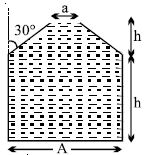
The vessel shown in the figure has two sections. The lower part is a rectangular vessel with area of cross-section $A$ and height $h$. The upper part is a conical vessel of height $h$ with base area $‘A’$ and top area $‘a’$ and the walls of the vessel are inclined at an angle $30^o$  with the vertical.A liquid of density $\rho$ fills both the sections upto a height $2h$. Neglecting atmospheric pressure. 
  • A
    The force $F $ exerted by the liquid on the base of the vessel is $2h\rho g$$\frac{{(A + a)}}{2}$
  • B
    the pressure $P $ at the base of the vessel is $2h\rho g $$\frac{A}{a}$
  • C
    the weight of the liquid $W $ is greater than the force exerted by the liquid on the base
  • the walls of the vessel exert a downward force $(F-W)$ on the liquid.
Answer

Correct option: D.
the walls of the vessel exert a downward force $(F-W)$ on the liquid.
d
$F=\rho g 2 h A$

Pressure at bottom is $P=\rho g 2 h$

Weight of liquid is $W=\rho g(2 A h-(A-a) h / 2)=\rho g(3 A h / 2+a h / 2)$

We can clearly see $F>W$

Downward forces due to wall is excess forces apart from weight $=F-W$

Need a full question paper?

Generate a complete, print-ready paper with questions like this in minutes — across 16+ boards, with answer keys.

Start Generating Free

Similar questions

A small, conducting circular loop is placed inside a long solenoid carrying a current. The plane of the loop contains the axis of the solenoid. If the current in the solenoid is varied, the current induced in the loop is:
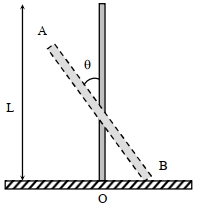
A rigid uniform bar $A B$ of length $L$ is slipping from its vertical position on a frictionless floor (as shown in the figure). At some instant of time, the angle made by the bar with the vortical is $\theta$. Which of the following statements about its motion is/are correct?

(image)

$[A]$ The midpoint of the bar will fall vertically downward

$[B]$ The trajectory of the point $\mathrm{A}$ is a parabola

$[C]$ Instantaneous torque about the point in contact with the floor is proportional to $\sin \theta$

$[D]$ When the bar makes an angle $\theta$ with the vertical, the displacement of its midpoint from the initial position is proportional to $(1-\cos \theta)$

A projectile is given an initial velocity of $(\hat i + 2\hat j)\ ms^{-1}$, where $\hat i$ is along the ground and $\hat j$ is along the vertical. If $g = 10\ m/s^2$ , the equation of its trajectory is
For which of the following gases the value of root mean square velocity at the same temperature will be minimum?
Four open organ pipes of different lengths and different gases at same temperature as shown in figure. Let $f_A$, $f_B$, $f_C$ and $f_D$ be their fundamental frequencies then :[Take ${\gamma _{c{o_2}}} = 7/5$]
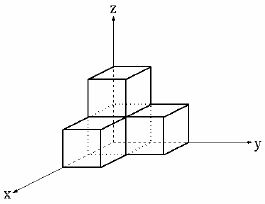
Find the center of mass $(x,y,z)$ of the following structure of four identical cubes if the length of each side of a cube is $1$ unit.
If the ratio of specific heat of a gas at constant pressure to that at constant volume is $\gamma $, the change in internal energy of a mass of gas, when the volume changes from $V$ to $2V$ constant pressure $ p$, is
The force required just to move a body up an inclined plane is double the force required just to prevent the body sliding down. If the coefficient of friction is $0.25$, the angle of inclination of the plane is ...... $^o$
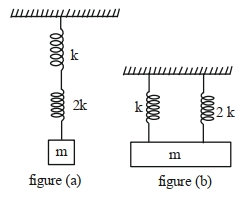
As per given figures, two springs of spring constants $K$ and $2\,K$ are connected to mass $m$. If the period of oscillation in figure $(a)$ is $3 s$, then the period of oscillation in figure $(b)$ will be $\sqrt{ x }$ s. The value of $x$ is$.........$
A tuning fork of frequency $280\,\, Hz$ produces $10$ beats per sec when sounded with a vibrating sonometer string. When the tension in the string increases slightly, it produces $11$ beats per sec. The original frequency of the vibrating sonometer string is ... $Hz$