MCQ
The viscous force acting between two layers of a liquid is given by $\frac{\text{F}}{\text{A}}=-\eta\frac{\text{dv}}{\text{dz}}$ This $\frac{\text{F}}{\text{A}}$ may be called:
  • A
    Pressure.
  • B
    Longitudinal stress.
  • Tangential stress.
  • D
    Volume stress.

Answer

Correct option: C.
Tangential stress.
Explanation:
The viscous force acts tangentially between two parallel layers of a liquid. In terms of force on a material, it is analogous to a shearing force.

Need a full question paper?

Generate a complete, print-ready paper with questions like this in minutes — across 16+ boards, with answer keys.

Start Generating Free

Similar questions

A photon with energy twice the work function of the metal is incident on the surface of the metal. The value of maximum kinetic energy of the emitted photoelectron will be :
Magnetic field in a current carrying solenoid is B. If length of the solenoid and current flowing through the solenoid is doubled, keeping the number of turns same, the magnitude of magnetic field in the solenoid will be:
Two identical metal plates show photoelectric effect by a light of wavelength $\lambda_A$ falls on plate A and $\lambda_B$ on plate B $\left(\lambda_A=2 \lambda_B\right)$. The maximum kinetic energy is
The refractive index of the material of the prism for violet colour is $1.69$ and that for red is $1.65.$ If the refractive index for mean colour is $1.66,$ the dispersive power of the material of the prism
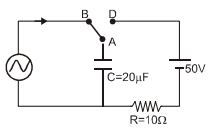
At time $t =0$, terminal $A$ in the circuit shown in the figure is connected to $B$ by a key and alternating current $I ( t )= I _0 \cos (\omega t$,$) , with I _0=1 A$ and $\omega=500 \ rad s ^{-1}$ starts flowing in it with the initial direction shown in the figure.

At $t=\frac{7 \pi}{6 \omega}$, the key is switched from $B$ to $D$. Now onwards on ly $A$ and $D$ are connected. $A$ total charge $Q$ flows from the battery to charge the capacitor fully. If $C =20 \mu, R =10 \Omega$ and the battery is ideal with emf of $50 \ V$, identify the correct statement $(s)$

$(A)$ Magnitude of the maximum charge on the capacitor before $t=\frac{7 \pi}{6 \omega}$ is $1 \times 10^{-3} C$.

$(B)$ The current in the left part of the circuit just before $t=\frac{7 \pi}{6 \omega}$ is clockwise

$(C)$ Immediately after $A$ is connected to $D$. the current in $R$ is $10 A$.

$(D)$ $Q =2 \times 10^{-3} C$.
An electron in hydrogen atom after absorbing energy photons can jump between energy states $n_1$ and $n_2(n_2 > n_1)$. Then it may return to ground state after emitting six different wavelengths in emission spectrum. the energy of emitted photons is either equal to, less than or greater than the absorbed photons. Then $n_1$ and $n_2$ are:
The two rails of a railways track, insulated from each other and the ground, are connected to a milli voltmeter. What is the reading of the milli voltmeter when a train travels at a speed of $20 ms^{-1}$ along the track, given that the vertical component of the earth's magnetic field is $0.2 \times 10^{-4} Wbm ^{-2}$ and the rails are separated by $1 m$ ?
The electric potential at the centre of a charged spherical conductor in comparison with the potential at the surface of the conductor:
A charge q coulomb moves in a circle at n revolutions per second and the radius of the circle is r metre. Then magnetic field at the centre of the circle is
Bohrs atomic model assumes: