MCQ
The voltage V and current I graph for a conductor at two different temperatures $\mathrm T_1$ and $\mathrm T_2$ are shown in the figure. The relation between $\mathrm T_1$ and $\mathrm T_2$ is
  • $\mathrm{T}_1>\mathrm{T}_2$
  • B
    $\mathrm{T}_1 \approx \mathrm{T}_2$
  • C
    $\mathrm{T}_1=\mathrm{T}_2$
  • D
    $\mathrm{T}_1<\mathrm{T}_2$

Answer

Correct option: A.
$\mathrm{T}_1>\mathrm{T}_2$
(a) $\mathrm{T}_1>\mathrm{T}_2$

Need a full question paper?

Generate a complete, print-ready paper with questions like this in minutes — across 16+ boards, with answer keys.

Start Generating Free

Similar questions

Alnico is used for making permanent magnets because it has:
A convex lens of power + 6D is placed in contact with a concave lens of power – 4D. What is the nature and focal length of the combination
The key feature of Bohr's theory of spectrum of hydrogen atom is the quantization of angular momentum when an electron is revolving around a proton. We will extend this to a general rotational motion to find quantized rotational energy of a diatomic molecule assuming it to be rigid. The rule to be applied is Bohr's quantization condition.

$1.$ A diatomic molecule has moment of inertia I. By Bohr's quantization condition its rotational energy in the $\mathrm{n}^{\text {th }}$ level ( $\mathrm{n}=0$ is not allowed) is

$(A)$ $\frac{1}{\mathrm{n}^2}\left(\frac{\mathrm{h}^2}{8 \pi^2 \mathrm{I}}\right)$ $(B)$ $\frac{1}{\mathrm{n}}\left(\frac{\mathrm{h}^2}{8 \pi^2 \mathrm{I}}\right)$

$(C)$ $n\left(\frac{h^2}{8 \pi^2 \mathrm{I}}\right)$ $(D)$ $\mathrm{n}^2\left(\frac{\mathrm{h}^2}{8 \pi^2 \mathrm{I}}\right)$

$2.$ It is found that the excitation frequency from ground to the first excited state of rotation for the $\mathrm{CO}$ molecule is close to $\frac{4}{\pi} \times 10^{11} \mathrm{~Hz}$. Then the moment of inertia of $\mathrm{CO}$ molecule about its centre of mass is close to (Take $\mathrm{h}=2 \pi \times 10^{-34} \mathrm{Js}$ )

$(A)$ $2.76 \times 10^{-46} \mathrm{~kg} \mathrm{~m}^2$ $(B)$ $1.87 \times 10^{-46} \mathrm{~kg} \mathrm{~m}^2$

$(C)$ $4.67 \times 10^{-47} \mathrm{~kg} \mathrm{~m}^2$ $(D)$ $1.17 \times 10^{-47} \mathrm{~kg} \mathrm{~m}^2$

$3.$ In a $\mathrm{CO}$ molecule, the distance between $\mathrm{C}$ (mass $=12$ a.m.u) and $\mathrm{O}$ (mass $=16$ a.m.u.), where $1$ a.m.u. $=\frac{5}{3} \times 10^{-27} \mathrm{~kg}$, is close to

$(A)$ $2.4 \times 10^{-10} \mathrm{~m}$ $(B)$ $1.9 \times 10^{-10} \mathrm{~m}$

$(C)$ $1.3 \times 10^{-10} \mathrm{~m}$ $(D)$ $4.4 \times 10^{-11} \mathrm{~m}$

Give the answer question $1,2$ and $3.$
A coil having $N$ $turns$ is wound tightly in the form of a spiral with inner and outer radii $a$ and $b$ respectively. When a current $I$ passes through the coil, the magnetic field at the centre is
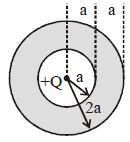
A solid spherical conducting shell has inner radius a and outer radius $2a$. At the center of the shell is located a point charge $+Q$. What must the excess charge of the shell be in order for the charge density on the inner and outer surfaces of the shell to be exactly equal ?
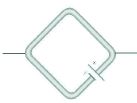
A square loop of side $1\,m$ is placed in a perpendicular magnetic field. Half of the area of the loop inside the magnetic field. A battery of $emf$ $10\, V$ and negligible internal resistance is connected in the loop. The magnetic field changes with time according to relation $B = (0.01 -2t)\, Tesla$. The resultant $emf$ in the loop will be.....$V$
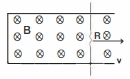
A conducting rod, with a resistor of resistance $R$, is pulled with constant speed $v$ on a smooth conducting rail as shown in figure. A constant magnetic field $B$ is directed into the page. If the speed of the bar is doubled, by what factor does the rate of heat dissipation across the resistance $R$ change?
A solid sphere, a hollow sphere and a disc, all having same mass and radius, are placed at the top of a smooth incline and released. Least time will be taken in reaching the bottom by:
A fully charged capacitor $C$ with initial charge $q_0$ is connected to a coil of self inductance $L$ at $t = 0$ . The time at which the energy is stored equally between the electric and the magnetic fields is
Two identical photo-cathodes receive light of frequencies ${f_1}$ and ${f_2}$. If the velocities of the photo electrons (of mass $m$) coming out are respectively ${v_1}$ and ${v_2}$, then