Question
The wave-like character was experimentally proved for light by:

Answer

  1. Young
Explanation:
Newton's particle theory remained accepted for a long time when it was challenged by the double-slit experiment of Thomas Young (1773-1829) in 1801. This experiment clearly established that light coming from two coherent sources interferes and produces maxima and minima depending on the path difference.

Need a full question paper?

Generate a complete, print-ready paper with questions like this in minutes — across 16+ boards, with answer keys.
Start Generating Free

Similar questions

The velocity of a particle is zero at t = 0.
  1. The acceleration at t = 0 must be zero.
  2. The acceleration at t = 0 may be zero.
  3. If the acceleration is zero from t = 0 to t = 10s, the speed is also zero in this interval.
  4. If the speed is zero from t = 0 to t = 10s the acceleration is also zero in this interval.
A capacitor of capacitance $500\mu\text{F}$ is connected to a battery through a $10\text{k}\Omega$ resistor. The charge stored in the capacitor in the first 5s is larger than the charge stored in the next:
  1. 5s
  2. 50s
  3. 500s
  4. 500
Magnetic meridian is:
The self inductance of a motor of an electric fan is 10H. In order to impart maximum power at 50Hz, it should be connected to a capacitance of:
The Kirchhoff's second law $\Big(\sum\text{iR}=\sum\text{E}\Big)$ where the symbols have their usual meanings, is based on:
Two short magnets with their axes horizontal and perpendicular to the magnetic meridian are placed with their centres $40 \ cm$ east and $50 \ cm$ west of magnetic needle. If the needle remains undeflected, the ratio of their magnetic moments $M_1: M_2$ is
Energy released in the fission of a single $92^{\mathrm{U}^{235}}$ nucleus is $200\ \text{MeV}.$The fission rate of a $92^{\mathrm{U}^{235}}$ fuelled reactor operating at a power level of $5W$ is
The colour of the positive column in a gas discharge tube depends on(a) The type of glass used to construct the tube(b) The gas in the tube (c) The applied voltage (d) The material of the cathode
   
   
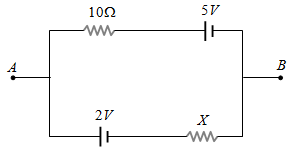
If $V_{AB} = 4V$ in the given figure, then resistance $X$ will be
Comparing real and virtual images, we may say that: