Question
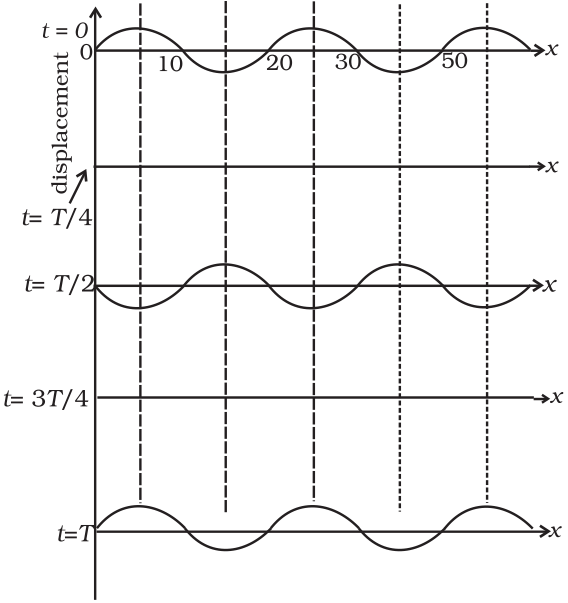
The wave pattern on a stretched string is shown in Interpret what kind of wave this is and find its wavelength.

Answer

The displacement of medium particlles at distance 10, 20, 30, 40, and 50cm are always rest which is the property of nodes in stationary wave.
$\text{AT}\ \text{t}=\frac{\text{T}}{4}$ and $\frac{\text{3T}}{4}$ all particle are at rest wgich is in stationary wave when the particle crossrs its mean position.
so thet praph of wave shos stationaty wave.
The wave at $\text{x}=10,\ 20,\ 30,\ 40\text{cm}$ there are nodes and distance between successive nodes is $\frac{\lambda}{2}$
$\therefore\frac{\lambda}{2}=(30-20)$ or $\lambda=20\text{cm.}$

Need a full question paper?

Generate a complete, print-ready paper with questions like this in minutes — across 16+ boards, with answer keys.
Start Generating Free

Similar questions

Find the magnetic field B at the centre of a rectangular loop of length l and width b, carrying a current i.
The temperature and humidity of air are 27°C and 50% on a particular day. Calculate the amount of vapour that should be added to 1 cubic metre of air to saturate it. The saturation vapour pressure at 27°C = 3600Pa.
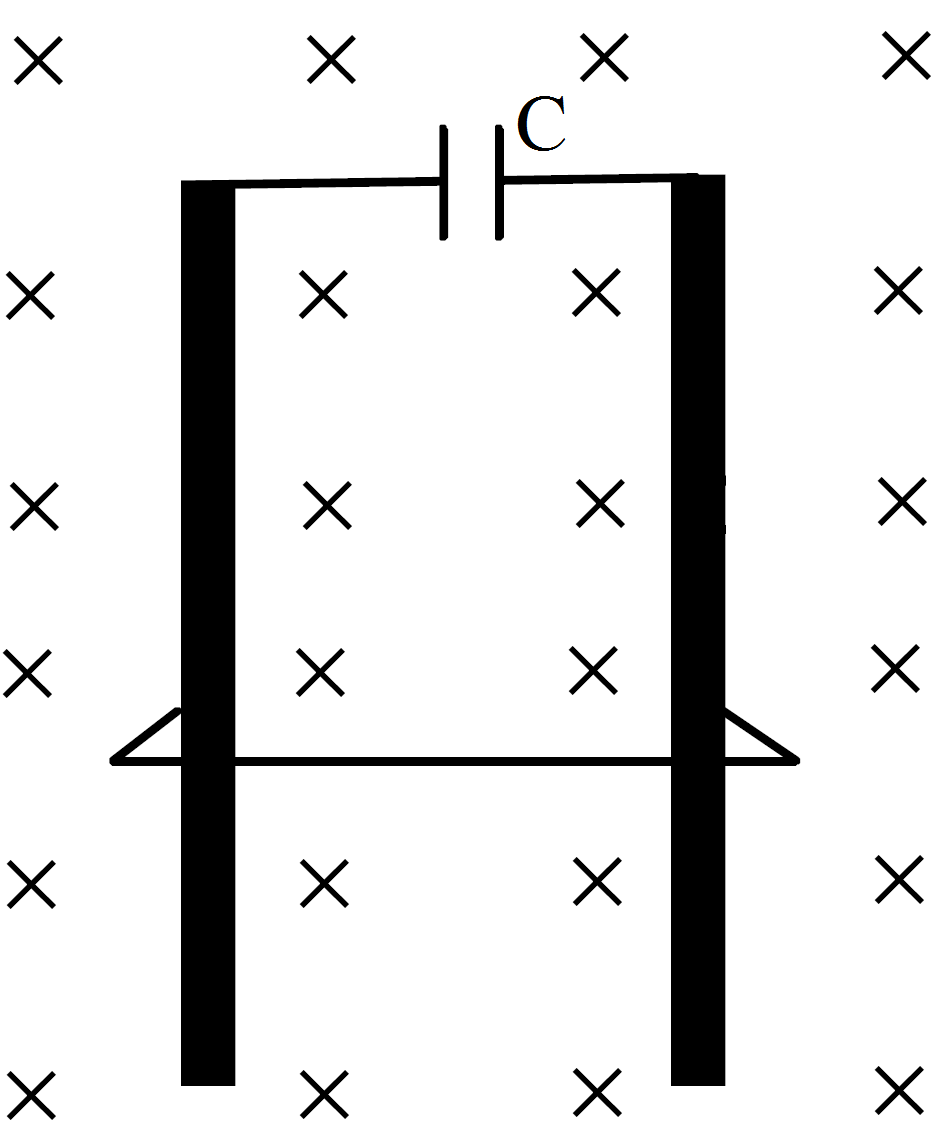
A wire of mass m and length l can slide freely on a pair of smooth, vertical rails (figure). A magnetic field B exists in the region in the direction perpendicular to the plane of the rails. The rails are connected at the top end by a capacitor of capacitance C. Find the acceleration of the wire neglecting any electric resistance.
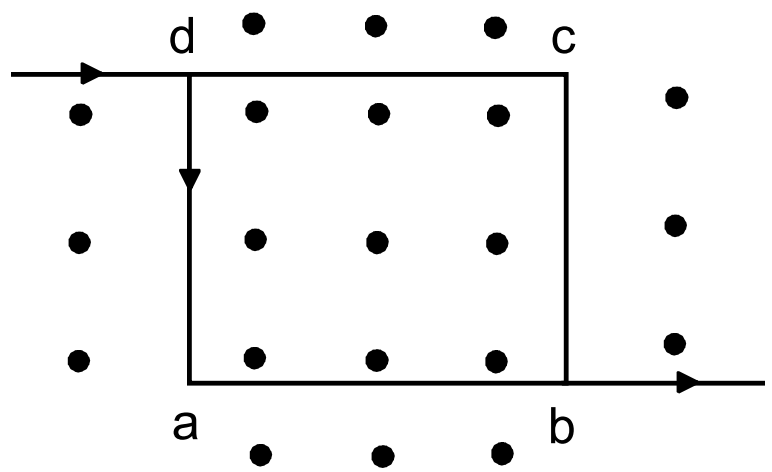
A current of 2A enters at the corner d of a square frame abcd of side 20cm and leaves at the opposite corner b. A magnetic field B = 0.1 T exists in the space in a direction perpendicular to the plane of the frame, as shown in the figure. Find the magnitude and direction of the magnetic forces on the four sides of the frame.
The molecules of a given mass of a gas have root mean square speeds of $1100 \mathrm{~ms}-$ at $27 \mathrm{C}^{\circ}$ and $1.00$ atmospheric pressure. What will be the root mean square speeds of the molecules of the gas at $127^{\circ} \mathrm{C}$ and $2.0$ atmospheric pressure?
A particle of mass $100g$ moving at an initial speed u collides with another particle of same mass kept initially at rest. If the total kinetic energy becomes $0.2J$ after the collision, what could be the minimum and the maximum value of u.
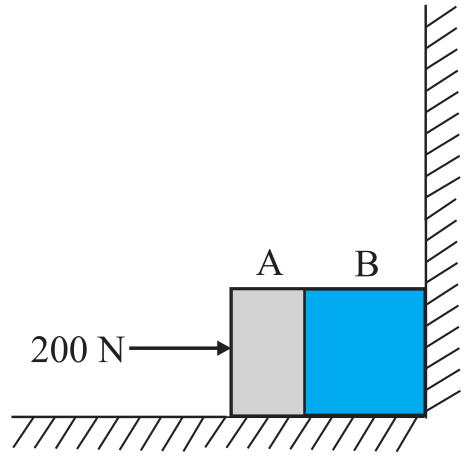
Two bodies A and B of masses 5kg and 10kg in contact with each other rest on a table against a rigid wall (Fig.). The coefficient of friction between the bodies and the table is 0.15. A force of 200N is applied horizontally to A. What are (a) the reaction of the partition (b) the action-reaction forces between A and B? What happens when the wall is removed? Does the answer to (b) change, when the bodies are in motion? Ignore the difference between $µ_s$ and $µ_k$.
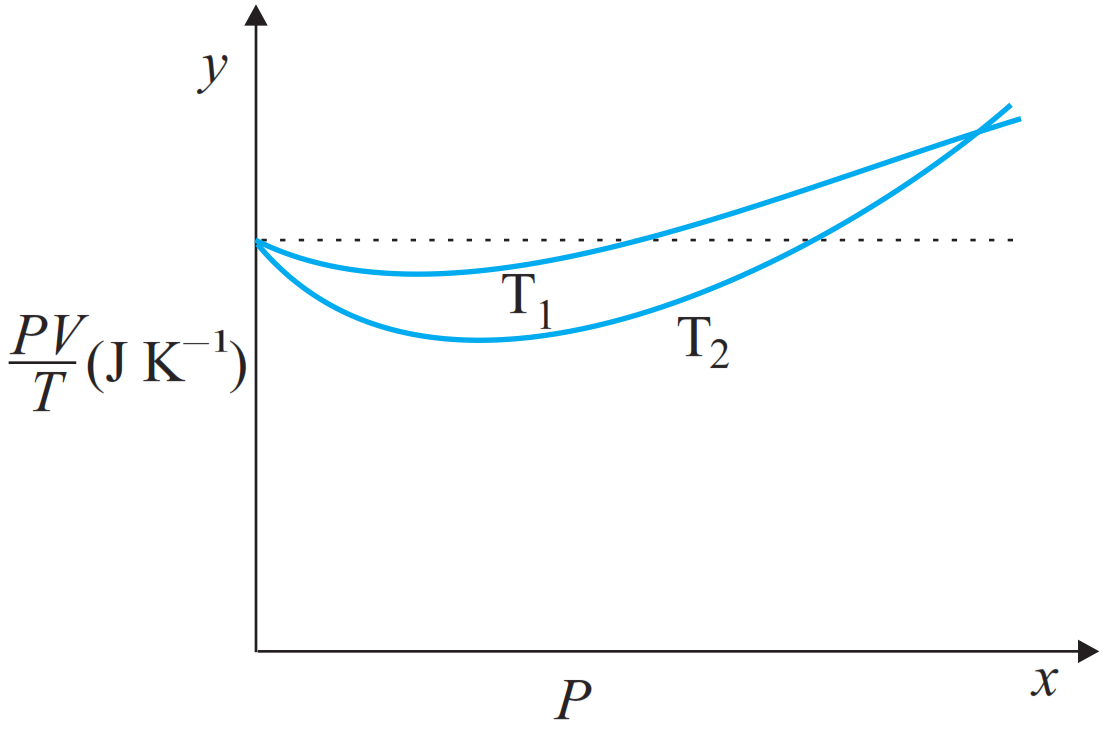
Shows plot of $\frac{\text{PV}}{\text{T}}$ versus P for $1.00 \times 10^{-3}kg$ of oxygen gas at two different temperatures: If we obtained similar plots for $1.00 \times 10^{-3}kg$ of hydrogen, would we get the same value of $\frac{\text{PV}}{\text{T}}$ at the point where the curves meet on the y-axis? If not, what mass of hydrogen yields the same value of $\frac{\text{PV}}{\text{T}}$ (for low pressure high temperature region of the plot)? (Molecular mass of $H_2 = 2.02u, of O_2 = 32.0u, R = 8.31J mo1^{-1}K^{-1}$).
A block of mass $2.0kg$ moving at $2.0m/s$ collides head on with another block of equal mass kept at rest.
  1. Find the maximum possible loss in kinetic energy due to the collision.
  2. If the actual loss in kinetic energy is half of this maximum, find the coefficient of restitution.
A chain of length l and mass m lies on the surface of a smooth sphere of radius R>1 with one end tied to the top of the sphere.
  1. Find the gravitational potential energy of the chain with reference level at the centre of the sphere.
  2. Suppose the chain is released and slides down the sphere. Find the kinetic energy of the chain, when it has slid through an angle $\theta.$
  3. Find the tangential acceleration $\frac{\text{dv}}{\text{dt}}$ of the chain when the chain starts sliding down.