MCQ
The wave theory in its original form was first postulated by:
- AIssac Newton
- BThomas Young
- CChristian Huygens
- DAugustine Jean Fresnel
Explanation:
Christian Huygens postulated wave theory.
Generate a complete, print-ready paper with questions like this in minutes — across 16+ boards, with answer keys.
For principal quantum number n = 3, the possible values of orbital quantum number ‘l’ are
|
(a) 1, 2, 3 |
(b) 0, 1, 2, 3 |
(c) 0, 1, 2 |
(d) –1, 0, +1 |
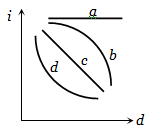
A point source of light is used in an experiment on photoelectric effect. Which of the following curves best represents the variation of photo current (i) with distance (d) of the source from the emitter
|
(a) a |
(b) b |
(c) c |
(d) d |
A house is served by 220 V supply line in a circuit protected by a 9 ampere fuse. The maximum number of 60 W lamps in parallel that can be turned on, is
|
(a) 44 |
(b) 20 |
(c) 22 |
(d) 33 |
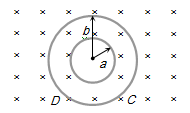
Plane figures made of thin wires of resistance R = 50 milli ohm/metre are located in a uniform magnetic field perpendicular into the plane of the figures and which decrease at the rate dB/dt = 0.1 m T/s. Then currents in the inner and outer boundary are. (The inner radius a = 10 cm and outer radius b = 20 cm)
|
(a) 10– 4 A (Clockwise), 2 × 10– 4 A (Clockwise) |
|
(b) 10– 4 A (Anticlockwise), 2 × 10– 4 A (Clockwise) |
|
(c) 2 × 10– 4 A (clockwise), 10– 4 A (Anticlockwise) |
|
(d) 2 × 10– 4 A (Anticlockwise), 10– 4 A (Anticlockwise) |
The resistance of a wire is  per metre. It is bend in the form of a circle of diameter 2 m. A wire of the same material is connected across its diameter. The total resistance across its diameter AB will be

|
(a) |
(b) |
(c) 0.88 |
(d) 14π |


