Question
The wave theory of light does not explain:

Answer

  1. Photocurrent.

Need a full question paper?

Generate a complete, print-ready paper with questions like this in minutes — across 16+ boards, with answer keys.
Start Generating Free

Similar questions

64 small drops of mercury, each of radius r and charge q coalesce to form a big drop. The ratio of the surface density of charge of each small drop with that of the big drop is(a) 1 : 64 (b) 64 : 1(c) 4 : 1    (d) 1 : 4
       
The permanent magnetic moment of the atoms of a material is not zero. The material:
  1. Must be paramagnetic.
  2. Must be diamagnetic.
  3. Must be ferromagnetic.
  4. May be paramagnetic.
An electric dipole is placed at an angle of 30° to a non-uniform electric field. The dipole will experience:
The maximum distance upto which $TV$ transmission from a $TV$ tower of height $h$ can be received is proportional to
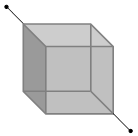
Twelve wires of equal length and same cross$-$section are connected in the form of a cube. If the resistance of each of the wires is $R,$ then the effective resistance between the two diagonal ends would be
The mass of a neutral carbon atom in ground state is:
A plane electromagnetic wave of frequency $28 \ MHz$ travels in free space along the positive $x-$direction. At a particular point in space and time, electric field is $9.3\ V/m$ along positive $y-$direction. The magnetic field $($in $T)$ at that point is
A bar magnet having centre $O$ has a length of $4 \ cm .$ Point $P_1$ is in the broad side-on and $P_2$ is in the end side$-$on position with $O P_1=O P_2=10$ metres. The ratio of magnetic intensities $H$ at $P_1$ and $P_2$ is
A charge $Q$ is uniformly distributed over a large plastic plate. The electric field at a point $P$ close to the centre of the plate is $10\ Vm^{-1}$. If the plastic plate is replaced by a copper plate of the same geometrical dimensions and carrying the same charge $Q,$ the electric field at the point $P$ will become:
A solid metallic sphere has a charge $+3Q$. Concentric with this sphere is a conducting spherical shell having charge $-Q$. The radius of the sphere is a and that of the spherical shell is $b(b > a)$. What is the electric field at a distance $R(a < R < b)$ from the centre