MCQ
The wave theory of light does not explain:
  • A
    Polarisation.
  • B
    Diffraction.
  • Photocurrent.
  • D
    Interference.

Answer

Correct option: C.
Photocurrent.

Need a full question paper?

Generate a complete, print-ready paper with questions like this in minutes — across 16+ boards, with answer keys.

Start Generating Free

Similar questions

In non-resonant circuit, what will be the nature of the circuit for frequencies higher than the resonant frequency?
Two charges + 5μC and +10 μC are placed 20 cm apart. The net electric field at the mid-Point between the two charges is
Which statement is correct for a zone plate and a lens
A point source of light moves in a straight line parallel to a plane table. Consider a small portion of the table directly below the line of movement of the source. The illuminance at this portion varies with its distance $r$ from the source as
A free neutron decays into a proton, an electron and
Magnetic permeability is maximum for
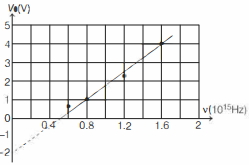
In a photocell circuit the stopping potential $V_0$ is a measure of the maximum kinetic energy of the photoelectrons. The following graph shows experimentally measured values of stopping potential versus frequency $v$ of incident light. The values of Planck's constant and the work function as determined from the graph are (taking, the magnitude of electronic charge to be $e=1.6 \times 10^{-19} C$ )
An achromatic convergent lens of focal length $20\,cms$ is made of two lenses (in contact) of materials having dispersive powers in the ratio of $1 : 2$ and having focal lengths $f_1$ and $f_2$. Which of the following is true ?
If the refractive index of the material of a prism is $\cot \left(\frac{A}{2}\right)$, where $A$ is the angle of prism then the angle of minimum deviation will be
A series $LR$ circuit is connected to an ac source of frequency $\omega $ and the inductive reactance is equal to $2R$. A capacitance of capacitive reactance equal to $R$ is added in series with $L$ and $R$. The ratio of the new power factor to the old one is