Question
The wavelength of light in a medium is $\lambda=\frac{\lambda_0}{\mu},$ where $\lambda$ is the wavelength in vacuum. A beam of red light $(\lambda_0=720\text{nm})$ enters into water. The wavelength in water is $\lambda=\frac{\lambda_0}{\mu}=540\text{nm}.$ To a person under water does this light appear green?
Answer

Colour of light will depend only on the frequency of light and not on the wavelength of the light. So, light will appear red to an observer under water.

Need a full question paper?

Generate a complete, print-ready paper with questions like this in minutes — across 16+ boards, with answer keys.

Start Generating Free

Similar questions

What is called point dipole?
An immersion heater rated 1000W, 220V is used to heat 0.01m3 of water. Assuming that the power is supplied at 220V and 60% of the power supplied is used to heat the water, how long will it take to increase the temperature of the water from 15°C to 40°C?
Two electric dipoles whose dipole moments are $P$ and 64 P are placed on a line at a distance of 25 cm in opposite directions. If the electric field at any point between them is zero, then what will be the distance of this point from the electric potential $P$ ?
Write any three characteristics, a ferromagnetic substance should possess if it is to be used to make a permanent magnet. Give one example of such a material.
A spherical surface of radius 30cm separates two transparent media A and B with refractive indices 1.33 and 1.48 respectively. The medium A is on the convex side of the surface. Where should a point object be placed in medium A so that the paraxial rays become parallel after refraction at the surface?
Show that the slope of p-V diagram is greater for an adiabatic process as compared to an isothermal process.
Derive Einstein's Photoelectric equation.
If the solenoid in Exercise 5.5 is free to turn about the vertical direction and a uniform horizontal magnetic field of 0.25 T is applied, what is the magnitude of torque on the solenoid when its axis makes an angle of 30° with the direction of applied field?
Describe briefly with the help of a circuit diagram, how the flow of current carriers in a p-n-p transistor is regulated with emitter-base junction forward biased and base-collector junction reverse biased.
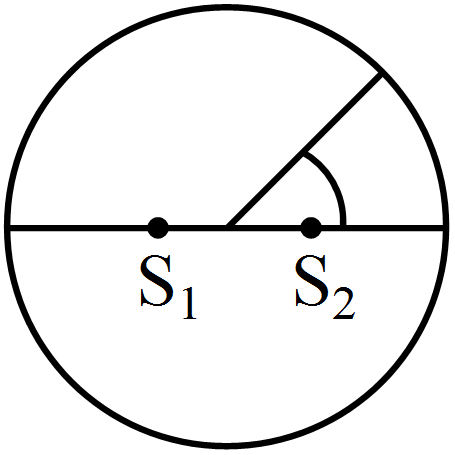
Figure, shows two coherent sources S1 and S2 which emit sound of wavelength $\lambda$ in phase. The separation between the sources is $3\lambda.$ A circular wire of large radius is placed in such a way that S1S2 lies in its plane and the middle point of S1S2 is at the centre of the wire. Find the angular positions $\theta$ on the wire for which constructive interference takes place.