MCQ
The wavelength of maximum energy, released during an atomic explosion, was $2.93 \times 10^{-10} \mathrm{~m}$. Given that the Wien's constant is $2.93 \times 10^{-3} \mathrm{~m} \mathrm{~K}$, the maximum temperature attained must be of the order of
  • A
    $ 10^{-7} \mathrm{~K} $
  • $ 10^7 \mathrm{~K} $
  • C
    $ 10^{-13} \mathrm{~K} $
  • D
    $ 5.86 \times 10^7 \mathrm{~K} $

Answer

Correct option: B.
$ 10^7 \mathrm{~K} $

Need a full question paper?

Generate a complete, print-ready paper with questions like this in minutes — across 16+ boards, with answer keys.

Start Generating Free

Similar questions

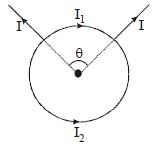
Assertion : The magnetic field at the centre of the circular coil in the following figure due to the currents $I_1$ and $I_2$ is zero.

Reason : $I_1 = I_2$ implies that the fields due to the current $I_1$ and $I_2$ will be balanced.

A radioactive material has an initial amount $16\, gm$. After $120$ days it reduces to $1 \,gm$, then the half-life of radioactive material is ..........$days$
In a Young’s double slit experiment the ratio of the slit’s width is $4 : 1.$ The ratio of the intensity of maxima to minima, close to central fringe on the screen will be
The electrostatic force between the metal plates of an isolated parallel plate capacitor $C$ having a charge $Q$ and area $A$, is:
A ray of light passing through a prism $(\mu=\sqrt{3})$ suffers minimum deviation. It is found that the angle of incidence is double the angle of refraction within the prism. Then, the angle of prism is ..... . (in degrees)
In the nuclear reaction: X(n, α) $3^{\mathrm{Li}^7}$ the term X will be 3
A ray of light is incident on a transparent glass slab of refractive index $1.62$. The reflected and the refracted rays are mutually perpendicular. The angle of incidence is.......$^o$
A nucleus of an element $_{84}{X^{202}}$ emits an $\alpha-$ particle first, a $\beta-$ particle next and then a gamma photon. The final nucleus formed has an atomic number
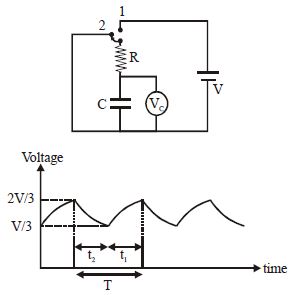
The switch in circuit shifts from $1$ to $2$ when $V_C > 2V/3$ and goes back to $1$ from $2$ when $V_C < V/3$ . The voltmeter reads voltage as plotted. What is the period $T$ of the wave form in terms of $R$ and $C$ ?
The lamp whose working is based on a discharge tube is $.......$: