MCQ
The wavelength of $X-$ rays decreases, when
  • A
    Temperature of target is increased
  • B
    Intensity of electron beam is increased
  • $K.E.$ of electrons striking the target is increased
  • D
    $K.E.$ of electrons striking the target is decreased

Answer

Correct option: C.
$K.E.$ of electrons striking the target is increased
c
(c) ${\lambda _{\min }} = \frac{{hc}}{{eV{\rm{(energy)}}}};$

when $KE$ (or $eV)$ increases, $\lambda $ decreases.

Need a full question paper?

Generate a complete, print-ready paper with questions like this in minutes — across 16+ boards, with answer keys.
Start Generating Free

Similar questions

The ultimate individual unit of magnetism in any magnet is called
An electron makes a transition from orbit n = 4 to the orbit n = 2 of a hydrogen atom. The wave number of the emitted radiations (R = Rydberg's constant) will be
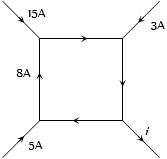
The figure shows a network of currents. The magnitude of currents is shown here. The current $i$ will be ................. $A$
Two free parallel wires carrying currents in opposite direction
The plate resistance of a triode is $2.5 ×10^{4}$ $\Omega$ and mutual conductance is $2 ×10^{-3}$ mho. What will be the value of amplification factor
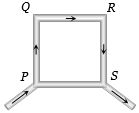
$PQRS$ is a square loop made of uniform conducting wire the current enters the loop at $P$ and leaves at $S$. Then the magnetic field will be
By using only two resistance coils-singly, in series, or in parallel one should be able to obtain resistances of $3$, $4$, $12$ and $16\, ohms$. The separate resistances of the coil are
In a Young’s double slit experiment, the separation of the two slits is doubled. To keep the same spacing of fringes, the distance D of the screen from the slits should be made 
The $\beta$-decay process, discovered around $1900$ , is basically the decay of a neutron ( $n$ ), In the laboratory, a proton ( $p$ ) and an electron ( $e ^{-}$) are observed as the decay products of the neutron. therefore, considering the decay of a neutron as a tro-body dcay process, it was predicted theoretically that thekinetic energy of the electron should be a constant. But experimentally, it was observed that the electron kinetic energy has a continuous spectrum. Considering a three-body decay process, i.e. $n \rightarrow p+ e ^{-}+\bar{v}_{ e }$, around $1930,$ Pauli explained the observed electron energy spectrum. Assuming the anti-neutrino $\left(\bar{v}_{ e }\right)$ to be massless and possessing negligible energy, and neutron to be at rest, momentum and energy conservation principles are applied. From this calculation, the maximum kinetic energy of the lectron is $0.8 \times 10^6 eV$. The kinetic energy carried by the proton is only the recoil energy.

$1.$ What is the maximum energy of the anti-neutrino?

$(A)$ Zero

$(B)$ Much less than $0.8 \times 10^6 \ eV$

$(C)$ Nearly $0.8 \times 10^6 \ eV$

$(D)$ Much larger than $0.8 \times 10^6 \ eV$

$2.$ If the anti-neutrino had a mass of $3 eV / c ^2$ (where $c$ is the speed of light) instead of zero mass, what should be the range of the kinetic energy, $K$, of the electron?

$(A)$ $0 \leq K \leq 0.8 \times 10^6 \ eV$

$(B)$ $3.0 eV \leq K \leq 0.8 \times 10^6 \ eV$

$(C)$ $3.0 eV \leq K < 0.8 \times 10^6 \ eV$

$(D)$ $0 \leq K < 0.8 \times 10^6 \ eV$

Give the answer question $1$ and $2.$

The mutual inductance of a pair of coils, each of $N\,turns$, is $M\,henry$. If a current of $I\, ampere$ in one of the coils is brought to zero in $t$ $second$ , the $emf$ induced per turn in the other coil, in volt, will be