The waves in which the particles of the medium vibrate in a direction perpendicular to the direction of wave motion is known as
AIIMS 1998, Easy
Download our app for free and get started
(a) In transverse waves medium particles vibrate perpendicular to the direction of propagation of wave.

Download our appand get started for free
Experience the future of education. Simply download our apps or reach out to us for more information. Let's shape the future of learning together!No signup needed.*
Similar Questions
- 1For the stationary wave $y = 4\sin \,\left( {\frac{{\pi x}}{{15}}} \right)\cos (96\,\pi t)$, the distance between a node and the next antinode isView Solution
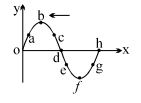
- 2The figure represents the instantaneous picture of a transverse harmonic wave traveling along the negative $x$-axis. Choose the correct alternative $(s)$ related to the movement of the nine points shown in the figure. The points moving with maximum velocity is/areView Solution
- 3View SolutionWhich of the following statements is incorrect during propagation of a plane progressive mechanical wave ?
- 4Two sources of sound of same frequency are placed at a distance of $100\,m$ from each other. An observer moving in between them hears $4$ beats per second. If the distance between the sound sources is increased to $400\,m$, then number of beats heard by him will be :-View Solution
- 5Two trains move towards each other with the same speed. The speed of sound is $340 \;m / s$. If the height of the tone of the whistle of one of them heard on the other changes $9 / 8$ times, then the speed of each train should be ........... $m/sec$View Solution
- 6The ratio of intensities between two coherent soud sources is $4 : 1$. The differenmce of loudness in $dB$ between maximum and minimum intensities when they interfere in space is:View Solution
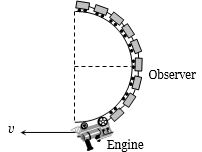
- 7A train has just complicated a $U-$curve in a track which is a semicircle. The engine is at the forward end of the semi circular part of the track while the last carriage is at the rear end of the semicircular track. The driver blows a whistle of frequency $200 Hz.$ Velocity of sound is $340 m/sec$. Then the apparent frequency as observed by a passenger in the middle of a train when the speed of the train is $30 m/sec$ is ... $Hz$View Solution
- 8A wave equation is given as $y = cos\,\,(500t - 70x),$ where $y$ is in $mm$, $x$ in $m$ and $t$ is in $sec$.View Solution
- 9Two open organ pipes give $4$ beats/sec when sounded together in their fundamental nodes. If the length of the pipe are $100 cm$ and $102.5 cm$ respectively, then the velocity of sound is ..... $m/s$View Solution
- 10The equation of a progressive wave is $y = 8\sin \left[ {\pi \left( {\frac{t}{{10}} - \frac{x}{4}} \right) + \frac{\pi }{3}} \right]$. The wavelength of the wave is .... $m$View Solution