MCQ
The weight of man in a lift moving with same acceleration upwards is $608\,N$ , while the weight of the same man in the life moving down wards with the same acceleration is $368\,N$ . His normal weight is ............ $N$
  • A
    $480$
  • $488$
  • C
    $588$
  • D
    $240$

Answer

Correct option: B.
$488$
b
When the life accelerates at a upwards

$m(g+a)=608$           $...(1)$

when the lift accelerates at a downwards

$m(g-a)=368$            $...(2)$

eq. $(1)+$ eq. $( 2)$

$\Rightarrow 2 \mathrm{mg}=608+368$

$\Rightarrow \mathrm{mg}=\frac{976}{2}=488 \mathrm{N}$

Need a full question paper?

Generate a complete, print-ready paper with questions like this in minutes — across 16+ boards, with answer keys.

Start Generating Free

Similar questions

In Carnot engine the work done by working substance is equivalent to
An athlete throws a discus from rest to a final angular velocity of $15\, rad\, s^{-1}$ in $0.270\, s$ before releasing it. During acceleration, discus moves a circular arc of radius $0.810\, m$. Acceleration of discus before it is released is ....... $ms^{-2}$.
A particle of mass $m$ is attached to a light string of length $l$, the other end of which is fixed. Initially the string is kept horizontal and the particle is given an upward velocity $v.$ The particle is just able to complete a circle.
  1. The string becomes slack when the particle reaches its highest point.
  2. The velocity of the particle become zero at the highest point.
  3. The kinetic energy of the ball in initial position was $\frac{1}{2}\text{m}\nu^2=\text{mgl}.$
  4. The particle again passes through the initial position.
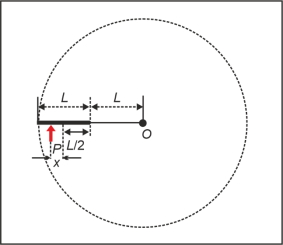
A thin uniform rod of length $L$ and certain mass is kept on a frictionless horizontal table with a massless string of length $L$ fixed to one end (top view is shown in the figure). The other end of the string is pivoted to a point $O$. If a horizontal impulse $P$ is imparted to the rod at a distance $x=L / n$ from the mid-point of the rod (see figure), then the rod and string revolve together around the point $O$, with the rod remaining aligned with the string. In such a case, the value of $n$ is. . . . . . 
A particle moves in a region having a uniform magnetic field and a parallel, uniform electric field. At some instant, the velocity of the particle is perpendicular to the field direction. The path of the particle will be:
A particle is projected from ground with velocity $u$ at angle $\theta$ from horizontal. Match the following two columns.
Column $I$ Column $II$
$(A)$ Average velocity between initial and final points $(p)$ $u \sin \theta$
$(B)$ Change in velocity between initial and final points $(q)$ $u \cos \theta$
$(C)$ Change in velocity between initial and final points $(r)$ Zero
$(D)$ Average velocity between initial and highest points $(s)$ None of the above
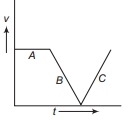
The velocity-time graph of a body is shown in figure. It implies that at point $B$
A body rotates about a fixed axis with an angular acceleration of $3 \,rad / s ^2$. The angle rotated by it during the time when its angular velocity increases from $10 \,rad / s$ to $20 \,rad / s$ (in radian) is ..........
A string of $7 \;m$ length has a mass of $0.035\,kg$. If tension in the string is $60.5\; N,$ then speed of a wave on the string is .... $m/s$
Two mercury drops (each of radius $r$) merge to form a bigger drop. The surface energy of the bigger drop, if $T$ is the surface tension is