MCQ
The wires 1 and 2
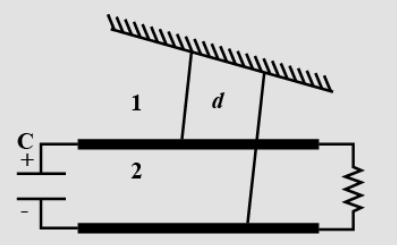
- AMove apart
- BCome closer
- CRemain at their position
- DNone of these
Explanation:
It is evident from the question that current in the two is in opposite direction so on using the formulas of current carrying straight conductor we can say that they will repel each other.
Generate a complete, print-ready paper with questions like this in minutes — across 16+ boards, with answer keys.
Assertion : The resistance of super-conductor is zero.
Reason : The super-conductors are used for the transmission of electric power.
|
(a) If both assertion and reason are true and the reason is the correct explanation of the assertion. |
|
(b) If both assertion and reason are true but reason is not the correct explanation of the assertion. |
|
(c) If assertion is true but reason is false. |
|
(d) If the assertion and reason both are false. |
If in the experiment of Wheatstone's bridge, the positions of cells and galvanometer are interchanged, then balance points will
|
(a) Change |
|
(b) Remain unchanged |
|
(c) Depend on the internal resistance of cell and resistance of galvanometer |
|
(d) None of these |
3.8 days is the half-life period of a sample. After how many days, the sample will become 1/8th of the original substance
|
(a) 11.4 |
(b) 3.8 |
(c) 3 |
(d) None of these |