MCQ
The work done in rotational motion is:
  • A
    $\vec{\tau} \cdot \vec{\alpha}$
  • $\vec{\tau} \cdot \overrightarrow{\Delta \theta}$
  • C
    $\vec{\tau} \cdot \vec{\omega}$
  • D
    $\overrightarrow{ L } \cdot \overrightarrow{\Delta \theta}$

Answer

Correct option: B.
$\vec{\tau} \cdot \overrightarrow{\Delta \theta}$
B

Need a full question paper?

Generate a complete, print-ready paper with questions like this in minutes — across 16+ boards, with answer keys.
Start Generating Free

Similar questions

Your friend driving his car overtakes your car on the highway. Which of the following statement must be true at the instant he is passing you? Assume the cars as point particles.
There are two spherical balls $A$ and $B$ of the same material with same surface, but the diameter of $A$ is half that of $B$. If $A$ and $B$ are heated to the same temperature and then allowed to cool, then
A simple harmonic oscillator has a period of $0.01 \,sec$ and an amplitude of $0.2\, m$. The magnitude of the velocity in $m{\sec ^{ - 1}}$ at the centre of oscillation is
A screen is placed a distance 40cm away from an illuminated object. A converging lens is placed between the source and the screen and it is attempted to form the image of the source on the screen. If no position could be found, the focal length of the lens:
The equation $\left( {P + \frac{a}{{{V^2}}}} \right)$ $(V - b)$ constant. The units of $a$ are
A gun applies a force $F$ on a bullet which is given by $F =\left(100-0.5 \times 10^{5} t \right) N$. The bullet emerges out with speed $400 \,m / s$. Then find out the impulse exerted till force on bullet becomes zero. (in $N - s$)
A book is lying on the table. What is the angle between the action of the book on the table and reaction of the table on the book?
Velocity of a body on reaching the point from which it was projected upwards, is
Two waves of frequencies $20 Hz$ and $30 Hz.$ Travels out from a common point. The phase difference between them after $0.6 sec$ is
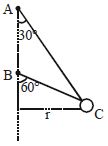
A single wire $ACB$ passes through a smooth ring at $C$ which revolves at a constant speed in the horizontal circle of radius $r$ as shown in the figure. The speed of revolution is