Question
The work function for a certain metal is $4.2 eV.$ Will this metal give photoelectric emission for incident radiation of wavelength $330\ nm?$

Answer

No
Work function of the metal, $\phi_\circ=4.2\ \text{eV}$
Charge on an electron, $e = 1.6 \times 10^{-19} C$
Planck's constant, $h = 6.626 \times 10^{-34} Js$
Wavelength of the incident radiation, $\lambda=330\ \text{nm}=330\times10^{-9}\ \text{m}$
Speed of light, $c = 3 \times 10^8 m/s$
The energy of the incident photon is given as:
$\text{E}=\frac{\text{hc}}{\lambda}$
$=\frac{6.626\times10^{-34}\times3\times10^{8}}{330\times10^{-9}}=6.0\times10^{-19}\ \text{J}$
$=\frac{6.0\times10^{-19}}{1.6\times10^{-19}}=3.76\ \text{eV}$
It can be observed that the energy of the incident radiation is less than the work function of the metal.
Hence, no photoelectric emission will take place.

Need a full question paper?

Generate a complete, print-ready paper with questions like this in minutes — across 16+ boards, with answer keys.
Start Generating Free

Similar questions

Can X-rays be used for photoelectric effect?
A resistance R and a capacitor C are connected in series to a source $\text{V}=\text{V}_0\sin\omega\text{t}.$
Find:
  1. The peak value of the voltage across the (i) resistance and (ii) capacitor.
  2. The phase difference between the applied voltage and current. Which of them is ahead?

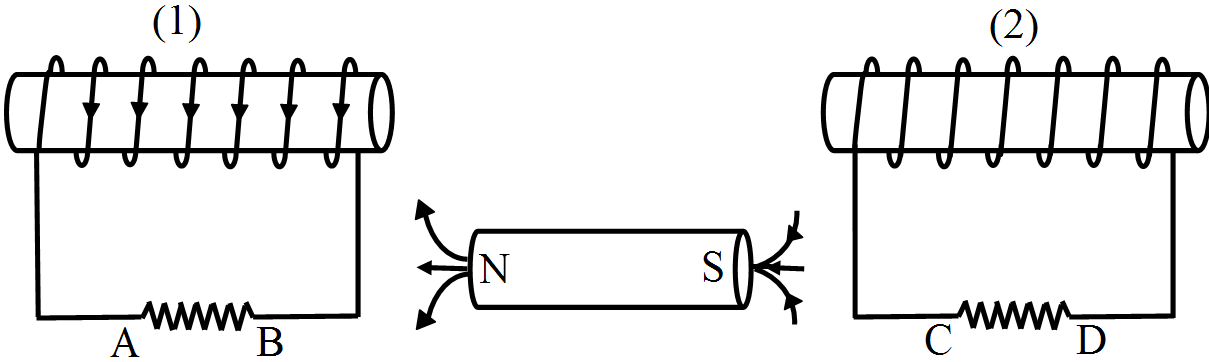
In the figure given below, a bar magnet moving towards the right or left induces an emf in the coils (1) and (2). Find, giving reason, the directions of the induced currents through the resistors AB and CD when the magnet is moving (a) towards the right, and (b) towards the left.
Define the term work function of a metal. The threshold frequency of a metal is $2f_0$. When the light of frequency $2f_0$ is incident on the metal plate, the maximum velocity of electrons emitted is $v_1$ When the frequency of the incident radiation is increased to $5f_0$ the maximum velocity of electrons emitted is $v_2$. Find the ratio of $v_1$ to $v_2$.
i. Will the earth's magnetic field induce current in an artificial satellite with a metal surface that is in orbit around the equator? Around the poles?
ii. If so how would these currents affect the motion of the satellite?
If one of the two electrons of a $H_2$ molecule is removed, we get a hydrogen molecular ion $\text{H}^+_2​.$ In the ground state of an $\text{H}^+_2​,$ the two protons are separated by roughly $1.5 \mathring A ,$ and the electron is roughly $1 \mathring A$ from each proton. Determine the potential energy of the system. Specify your choice of the zero of potential energy.
A monochromatic light source of intensity $6mW$ emits $8 \times 10^{16}$ photons per second. This light ejects photoelectrons from a metal surface. The stopping potential for this setup is $2.0V.$ Calculate the work function of the metal.
Explain that Kirchhoff's second law is law of conservation of energy.
Write Maxwell’s generalisation of Ampere’s Circuital Law. Show that in the process of charging a capacitor, the current produced within the plates of the capacitor is
$\text{i} = \varepsilon_{\circ}\frac{^{\text{d}\Phi}\text{E}}{\text{dt}}$ where $\Phi_{E}$ is the electric flux produced during charging of the capacitor plates.
Explain LOS mode of communication.