MCQ
The work function for photoelectric effect:
  • Is different for different metals.
  • B
    Is same for all metals.
  • C
    Depends upon the intensity of incident light.
  • D
    Depends upon the frequency of incident light.

Answer

Correct option: A.
Is different for different metals.

Need a full question paper?

Generate a complete, print-ready paper with questions like this in minutes — across 16+ boards, with answer keys.
Start Generating Free

Similar questions

One of the two small circular coils, (none of them having any self- inductance) is suspended with a $V-$ shaped copper wire, with plane horizontal. The other coil is placed just below the first one with plane horizontal. Both the coils are connected in series with a $dc$ supply. The coils are found to attract each other with a force. Which one of the following statements is incorrect ?
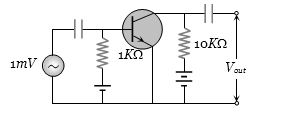
In the following common emitter configuration an $NPN $ transistor with current gain $\beta$ $= 100$ is used. The output voltage of the amplifier will be
The idea of the quantum nature of light has emerged in an attempt to explain
A steady current $I$ flows along an infinitely long hollow cylindrical conductor of radius $R$. This cylinder is placed coaxially inside an infinite solenoid of radius $2 \ R$. The solenoid has $n$ turns per unit length and carries a steady current $I$. Consider a point $P$ at a distance $r$ from the common axis. The correct statement$(s)$ is (are) :

$(A)$ In the region $0 < r < R$, the magnetic field is non-zero.

$(B)$ In the region $R < r < 2 R$, the magnetic field is along the common axis.

$(C)$ In the region $R < r < 2 R$, the magnetic field is tangential to the circle of radius $r$, centered on the axis.

$(D)$ In the region $r > 2 R$, the magnetic field is non-zero.

A sodium atom is in one of the states labeled 'Lowest excited levels'. It remains in that state for an average time of $10^{-8} \mathrm{sec}$, before it makes a transition back to a ground state. What is the uncertainty in energy of that excited state
The photoelectric effect can be understood on the basis of
The figure shows a bar magnet and a metallic coil. Consider four situations:

$(I)$ Moving the magnet away from the coil.

$(II)$ Moving the coil towards the magnet.

$(III)$ Rotating the coil about the vertical diameter.

$(IV)$ Rotating the coil about its axis.

An emf in the coil will be generated for the following situations.

At the magnetic north pole of the earth, the value of the horizontal component of earth’s magnetic field and angle of dip are respectively:
If the direction of the initial velocity of the charged particle is neither along nor perpendicular to that of the magnetic field, then the orbit will be
An electron, a proton and an alpha particle having the same kinetic energy are moving in circular orbits of radii $r_e,r_p$ and ${r_\alpha }$ respectively in a uniform magnetic field $B$. The relation between $r_e,r_p$ and $\;{r_\alpha }$ is