MCQ
The work function of a photoelectric material is $3.3 eV$. The threshold frequency will be equal to
  • A
    $8 \times {10^4}Hz$
  • B
    $8 \times {10^{56}}Hz$
  • C
    $8 \times {10^{10}}Hz$
  • $8 \times {10^{14}}Hz$

Answer

Correct option: D.
$8 \times {10^{14}}Hz$
d
(d) ${\nu _0} = \frac{{{W_0}}}{h} = \frac{{3.3 \times 1.6 \times {{10}^{ - 19}}}}{{6.6 \times {{10}^{ - 34}}}} = 8 \times {10^{14}}Hz$

Need a full question paper?

Generate a complete, print-ready paper with questions like this in minutes — across 16+ boards, with answer keys.

Start Generating Free

Similar questions

A source simultaneously emitting light at two wavelengths $400 \,nm$ and $800 \,nm$ is used in the Young's double slit experiment. If the intensity of light at the slit for each wavelength is $I_{0}$, then the maximum intensity that can be observed at any poin on the screen is
A car starts from rest and accelerates at $5 \,\mathrm{~m} / \mathrm{s}^{2}$. At $t=4 \mathrm{~s}$, a ball is dropped out of a window by a person sitting in the car. What is the velocity and acceleration of the ball at $\mathrm{t}=6\, \mathrm{~s}$ ?

(Take g $\left.=10\, \mathrm{~m} / \mathrm{s}^{2}\right)$

Cathode rays enter into a uniform magnetic field perpendicular to the direction of the field. In the magnetic field their path will be

Match List-I with List-II.

List-IList-II
(A)Mass density(I)$\left[\mathrm{ML}^{2} \mathrm{~T}^{-3}\right]$
(B)Impulse(II)$\left[\mathrm{MLT}^{-1}\right]$
(C)Power(III)$\left[\mathrm{ML}^{2} \mathrm{~T}^{0}\right]$
(D)Moment of inertia(IV)$\left[\mathrm{ML}^{-3} \mathrm{~T}^{0}\right]$
Choose the correct answer from the options given below :
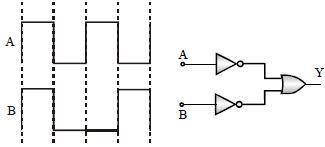
In the given circuit as shown the two input waveform $A$ and $B$ are applied  simultaneously. The resultant waveform $Y$ is
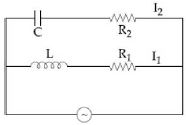
In the below circuit, $C\, = \,\frac{{\sqrt 3 }}{2}\,\mu F,\,R = 20\,\,\Omega ,\,L = \frac{{\sqrt 3 }}{{10}}H$ and ${R_1} = 10\,\,\Omega .$ Current in $L-R_1$ path is $I_1$ and $C-R_2$ path is $I_2.$ The voltage of $A.C$ source is given by, $V\, = \,200\sqrt 2 \,\sin \,(100\,t)\,volts.$ The phase difference between $I_1$ and $I_2$ is
The resistor of resistance '$R$' is connected to $25\, V$ supply and heat produced in it is $25\, J/sec$. The value of $R$ is .......... $\Omega $
The equation of motion of a particle is $\frac{{{d^2}y}}{{d{t^2}}} + Ky = 0$, where $K$ is positive constant. The time period of the motion is given by
The potential energy of a particle of mass $0.1\,kg,$ moving along $x-$ axis, is given by $U = 5x(x-4)\,J$ where $x$ is in metres. It can be concluded that
The elasticity of invar