MCQ
The working of dynamo is based on principle of
  • Electromagnetic induction
  • B
    Conversion of energy into electricity
  • C
    Magnetic effects of current
  • D
    Heating effects of current

Answer

Correct option: A.
Electromagnetic induction
a
(a)Rotation of magnet in the dynamo creates the variable flux which in turn produces the induced current.

Need a full question paper?

Generate a complete, print-ready paper with questions like this in minutes — across 16+ boards, with answer keys.
Start Generating Free

Similar questions

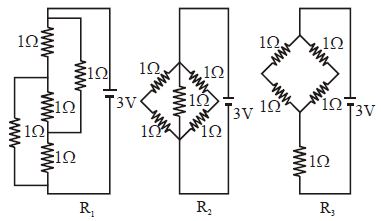
Figure shows three resistor configurations $R_1,R_2$ and $R_3$ connected to $3\,V$ battery. If the power dissipated by the configuration $R_1, R_2$ and $R_3$ is $P_1, P_2$ and $P_3$ , respectively then
If momentum of a body is increased by $20 \%$, then its kinetic energy increases by$....\%$
When the temperature of a rod increases from $t$ to $\left( {t + \Delta t} \right)$, its moment of inertia increases from $I$ to $\left( {I + \Delta I} \right)$. If $\alpha $ be the coefficient of linear expansion of the rod, then the value of $\left( {\frac{{\Delta I}}{I}} \right)$ is
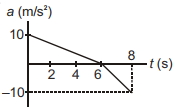
The acceleration-time graph for a particle moving along $x$-axis is shown in figure. If the initial velocity of particle is $-5 \,m / s$, the velocity at $t=8 \,s$ is ....... $m / s$
If a particle of mass $m$ is moving in a horizontal circle of radius $r$ with a centripetal force $( - k/{r^2})$, the total energy is
The mean free path of electrons in a metal is $4 \times 10^{-8} \;m$. The electric field which can give on an average $2 \;eV$ energy to an electron in the metal will be in units of $V / m$
A standing wave is represented by

$Y = A\sin (100t)\cos (0.01x)$

where $Y$ and $A$ are in millimetre, $t$ is in seconds and $x$ is in metre. The velocity of wave is ..... $m/s$

Two bodies $A$ & $B$ rotate about an axis, such that angle $\theta_A$ (in radians) covered by first body is proportional to square of time, & $\theta_B$ (in radians) covered by second body varies linearly. At $t = 0, \theta \,A = \theta \,B = 0$. If $A$ completes its first revolution in $\sqrt \pi$ sec. & $B$ needs $4\pi \,sec$. to complete half revolution then; angular velocity $\omega_A : \omega_B$ at $t = 5\, sec$. are in the ratio
The maximum vertical height to which a man can throw a ball is $136\,m$. The maximum horizontal distance upto which he can throw the same ball is $.....\,m$
Excess pressure of one soap bubble is four times more than the other. Then the ratio of volume of first bubble to another one is