MCQ
The worst enemy of ozone is :
  • A
    Liquid $\mathrm{NH}_3$
     
  • B
    $\mathrm{SO}_2$
  • C
    $ \mathrm{CH} 4$
  • $\text{CFCs}$

Answer

Correct option: D.
$\text{CFCs}$
The ozone hole is thinning of an ozone layer which is present in the stratosphere region around $26 - 30 \ \text{kms}$ above the Earth surface. The ozone hole is caused by chlorofluorocarbons $\text{(CFCs)}$ found in air conditioners, aerosol spray cans, refrigerants etc. $\text{CFCs}$ can not be removed in troposphere and moves in Stratosphere layer where it reacts with ozone, thereby releasing of free chlorine atoms and causes the ozone layer to deplete. It serves as a shield from the harmful ultraviolet $B$ radiation emitted by the sun. Ozone hole becomes a cause of concern as it allows $\text{UV}$ radiations to reach the earth surface which causes major problems like Skin cancer, reduction in the rate of photosynthesis.

Need a full question paper?

Generate a complete, print-ready paper with questions like this in minutes — across 16+ boards, with answer keys.

Start Generating Free

Similar questions

Which of the following is the most stable
Which of the following statement is not correct ?
In graphite, electrons are
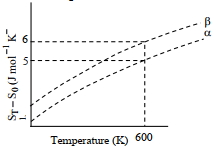
The entropy versus temperature plot for phases $\alpha$ and $\beta$ at 1 bar pressure is given. $S_{\mathrm{T}}$ and $S_0$ are entropies of the phases at temperatures $\mathrm{T}$ and $0 \mathrm{~K}$, respectively.

(image)

The transition temperature for $\alpha$ to $\beta$ phase change is $600 \mathrm{~K}$ and $C_{p, \beta}-C_{p, \alpha}=1 \mathrm{~J} \mathrm{~mol}^{-1} \mathrm{~K}^{-1}$. Assume $\left(C_{p, \beta}-C_{p, \alpha}\right)$ is independent of temperature in the range of 200 to $700 \mathrm{~K} . \mathrm{C}_{p, \alpha}$ and $C_{p, \beta}$ are heat capacities of $\alpha$ and $\beta$ phases, respectively.

($1$)The value of entropy change, $\mathrm{S}_\beta-\mathrm{S}_\alpha$ (in $\mathrm{J} \mathrm{mol}^{-1} \mathrm{~K}^{-1}$ ), at $300 \mathrm{~K}$ is. . . . . . .

[Use : $\ln 2=0.69$  Given : $S_\beta-S_\alpha=0$ at $\left.0 \mathrm{~K}\right]$

($2$) The value of enthalpy change, $\mathrm{H}_\beta-\mathrm{H}_\alpha$ (in $J$ mol ${ }^{-1}$ ), at $300 \mathrm{~K}$ is

Give the answer quetion ($1$) and ($2$)
Steam reacts with red hot iron to produce?
In a closed container of $1000\, cm^3$, $2\, mol\, PCl_5$, $2\, mol\, PCl_3$ and $3\, mol\, Cl_2$ are found to be at equilibrium at $27\,^oC$. Then $K_P$ for $PCl_5(g)  \rightleftharpoons  PCl_3(g) + Cl_2(g)$ at $27\,^oC$ is .....$ atm$
The distinguishing test for triple bond containing acidic hydrogen is
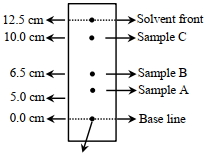
Using the given figure, the ratio of $R_t$ values of sample $A$ and sample $\mathrm{C}$ is $\mathrm{x} \times 10^{-2}$. Value of $\mathrm{x}$ is . . . . . . . . 

(Image)

Samples $(A, B, C)$

Fig : Paper chromatography of Samples
The solubility product of $\mathrm{Cr}(\mathrm{OH})_{3}$ at $298\; \mathrm{K}$ is $6.0 \times 10^{-31} .$ The concentration of hydroxide ions in a saturated solution of $\mathrm{Cr}(\mathrm{OH})_{3}$ will be
If oxalic acid is treated with conc. $H_2SO_4$ , then gases formed will be