MCQ
The $x$ - $t$ equation is given as $x=2 t+1$ The corresponding $v-t$ graph is
  • A
    a straight line passing through origin
  • a straight line not passing through origin
  • C
    a parabola
  • D
    None of the above

Answer

Correct option: B.
a straight line not passing through origin
b
(b)

$v=\frac{d x}{d t}=2\,m / s =$ constant

Need a full question paper?

Generate a complete, print-ready paper with questions like this in minutes — across 16+ boards, with answer keys.
Start Generating Free

Similar questions

A particle gets displaced by $\Delta \,\vec r = \,(2\hat i + 3\hat j + 4\hat k)$ $m$ under the action of a force $\vec F = \,(7\hat i + 4\hat j + 3\hat k)$ The change in its kinetic energy is ............... $\mathrm{J}$
Four point masses, each of value $m$, are placed at the comers of a square $ABCD$ of side $l$. The moment of inertia of this system about an axis passing through $A$ and parallel to $BD$ is
A metal ball of surface area $200\;c{m^2}$ and temperature ${527^o}C$ is surrounded by a vessel at ${27^o}C$. If the emissivity of the metal is $0.4$ , then the rate of loss of heat from the ball is .......... $joules $ approx. $(\sigma = 5.67 \times {10^{ - 8}}J/{m^2}\; - s - {k^4})$
The gravitational potential energy of a body of mass $‘m’$ at the earth’s surface $ - mg{R_e}$. Its gravitational potential energy at a height ${R_e}$ from the earth’s surface will be (Here ${R_e}$ is the radius of the earth)
If an average person jogs, he produces $14.5 \times 103\ \text{cal/ min.}$ This is removed by the evaporation of sweat. The amount of sweat evaporated per minute $($assuming $1\ kg$ requires $580 \times 103\ \text{cal}$ for evaparation$)$ is
A thin rod of mass $m$ and length $l$ is oscillating about horizontal axis through its one  end. Its maximum angular speed is $\omega$. Its centre of mass will rise upto maximum  height :-
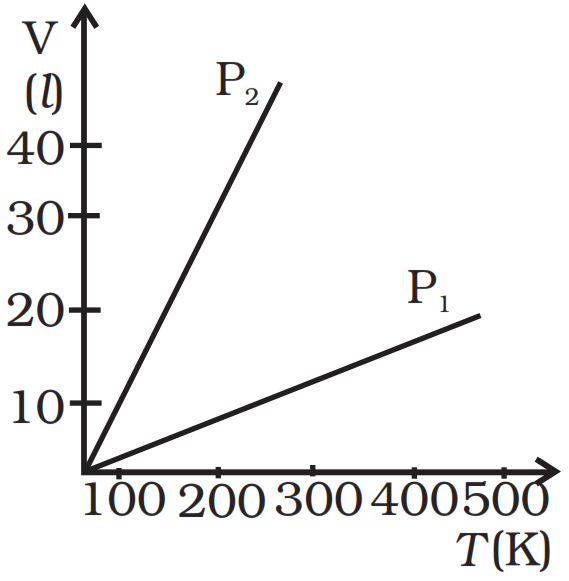
Volume versus temperature graphs for a given mass of an ideal gas are shown in figure. At two different values of constant pressure. What can be inferred about relation between $P_1$ and $P_2$?
A mass of $1\ kg$ attached to the bottom of a spring has a certain frequency of vibration. The following mass has to be added to it in order to reduce the frequency by half:
As the temperature of water increases, its viscosity
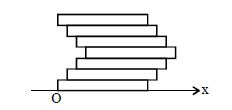
Seven identical homogeneous bricks, each of length $L$ , are arranged as shown in figure. Each brick is displaced with respect to the one in contacts by $\frac{L}{{10}}$ . Calculate the $x$-co-ordinate of the centre of mass of this system relative to the origin $O$ as shown