MCQ
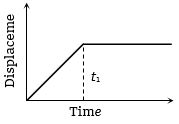
The $x - t$ graph shown in figure represents
  • A
    Constant velocity
  • B
    Velocity of the body is continuously changing
  • C
    Instantaneous velocity
  • The body travels with constant speed upto time ${t_1}$ and then stops

Answer

Correct option: D.
The body travels with constant speed upto time ${t_1}$ and then stops
d
(d)Up to time ${t_1}$ slope of the graph is constant and after ${t_1}$slope is zero i.e. the body travel with constant speed up to time ${t_1}$ and then stops.

Need a full question paper?

Generate a complete, print-ready paper with questions like this in minutes — across 16+ boards, with answer keys.

Start Generating Free

Similar questions

The shortest wavelength in Lyman series is $91.2\, nm$ . The largest wavelength of the series is.....$nm$
A current of $2\, amp$. flows in a long, straight wire of radius $2\, mm$. The intensity of magnetic field on the axis of the wire is
A car moving with a velocity of $10 \,m/s$ can be stopped by the application of a constant force $F$ in a distance of $20\, m$. If the velocity of the car is $30\, m/s$, it can be stopped by this force in......$m$
In $SI\, units$, the dimensions of $\sqrt {\frac{{{ \varepsilon _0}}}{{{\mu _0}}}} $ is
The angle between vector $\vec{Q}$ and the resultant of $(2 \overrightarrow{\mathrm{Q}}+2 \overrightarrow{\mathrm{P}})$ and $(2 \overrightarrow{\mathrm{Q}}-2 \overrightarrow{\mathrm{P}})$ is:
The wave described by $y=0.25 \,sin\left[ {10\pi x - 2\pi t} \right]$, where $x$ and $y$ are in meters and $t$ in seconds, is a wave travelling along the 
A screen is placed $90\;cm$ from an object. The image of the object on the screen is formed by a convex lens at two different locations separated by $20\;cm$. Determine the focal length (in $cm$) of the lens.
$A$ particle of mass m is constrained to move on $x$ -axis. $A$ force $F$ acts on the particle. $F$ always points toward the position labeled $E$. For example, when the particle is to the left of $E, F$ points to the right. The magnitude of $F$ is a constant $F$ except at point $E$ where it is zero. The system is horizontal. $F$ is the net force acting on the particle. The particle is displaced a distance $A$ towards left from the equilibrium position $E$ and released from rest at $t = 0.$ Velocity - time graph of the particle is
The graph which depicts the results of Rutherform gold foil experiment with $\alpha$ -particales is

$\theta:$ Scattering angle

$\mathrm{Y}:$ Number of scattered $\alpha$ -particles detected

(Plots are schematic and not to scale)

A block slides down an inclined plane of slope of angle $\theta $ with a constant velocity. It is then projected up the plane with an initial velocity $u$. The distance upto which it will rise before coming to rest is