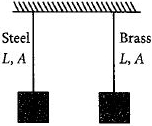
The Young's modulus of steel is twice that of brass. Two wires of same length and of same area of cross section, one of steel and another of brass are suspended from the same roof. If we want the lower ends of the wires to be at the same level, then the weights added to the steel and brass wires must be in the ratio of
AIPMT 2015, Medium


Download our appand get started for free
Experience the future of education. Simply download our apps or reach out to us for more information. Let's shape the future of learning together!No signup needed.*
Similar Questions
- 1The Young's modulus of a wire is $Y.$ If the energy per unit volume is $E$, then the strain will beView Solution
- 2The compressibility of water is $6 \times 10^{-10} N ^{-1} m ^{2} .$ If one litre is subjected to a pressure of $4 \times 10^{7} Nm ^{-2}$ the decrease in its volume is (in $cc$)View Solution
- 3A wire of length $5 \,m$ is twisted through $30^{\circ}$ at free end. If the radius of wire is $1 \,mm$, the shearing strain in the wire is $..........,.$View Solution
- 4A man grows into a giant such that his linear dimensions increase by a factor of $9$. Assuming that his density remains same, the stress in the leg will change by a factor ofView Solution
- 5Two wires $A$ and $B$ of same material have radii in the ratio $2: 1$ and lengths in the ratio $4: 1$. The ratio of the normal forces required to produce the same change in the lengths of these two wires is .......View Solution
- 6View SolutionIn suspended type moving coil galvanometer, quartz suspension is used because
- 7A metal wire of length $'L'$ is suspended vertically from a rigid support. When a body of mass $M$ is attached to the lower end of wire, the elongation in wire is $'l'$, consider the following statementsView Solution
$(I)$ the loss of gravitational potential energy of mass $M$ is $Mgl$
$(II)$ the elastic potential energy stored in the wire is $Mgl$
$(III)$ the elastic potential energy stored in wire is $\frac{1}{2}\, Mg l$
$(IV)$ heat produced is $\frac{1}{2}\, Mg l$
Correct statement are :-
- 8A uniform rod of mass $m$, length $L$, area of cross-section $A$ and Young's modulus $Y$ hangs from the ceiling. Its elongation under its own weight will beView Solution
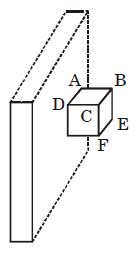
- 9A steel rod is projecting out of rigid wall. The shearing strength of steel is $345 \,\,MN/m^2.$ The dimensions $AB = 5\,\, cm,\,BC = BE = 2\,\, cm.$ The maximum load that can be put on the face $ABCD$ is .......... $kg$ (neglect bending of the rod) $(g = 10\,\, m/s^2)$View Solution
- 10Three bars having length $l, 2l$ and $3l$ and area of cross-section $A, 2 A$ and $3 A$ are joined rigidly end to end. Compound rod is subjected to a stretching force $F$. The increase in length of rod is (Young's modulus of material is $Y$ and bars are massless)View Solution