MCQ
The zeros of the polynomial $4\text{x}^2+5\sqrt2\text{x}-3$ are :
  • A
    $-3\sqrt2,\ \sqrt2$
  • B
    $-3\sqrt2,\ \frac{\sqrt2}{2}$
  • $\frac{-3\sqrt2}{2},\ \frac{\sqrt2}{4}$
  • D
    None of these.

Answer

Correct option: C.
$\frac{-3\sqrt2}{2},\ \frac{\sqrt2}{4}$
$\text{f}(\text{x})=4\text{x}^2+5\sqrt2\text{x}-3$
$=4\text{x}^2+6\sqrt2\text{x}-\sqrt2\text{x}-3$
$=2\sqrt2\text{x}\big(\sqrt2\text{x}+3\big)-1\big(\sqrt2\text{x}+3\big)$
$=\big(2\sqrt2\text{x}-1\big)\big(\sqrt2\text{x}+3\big)$
$\therefore\text{f}(\text{x})=0$
$\Rightarrow\big(2\sqrt2\text{x}-1\big)\big(\sqrt2\text{x}+3\big)=0$
$\Rightarrow2\sqrt2\text{x}-1=0$ or $\sqrt2\text{x}+3=0$
$\Rightarrow\text{x}=\frac{1}{2\sqrt2}$ or $\text{x}=-\frac{3}{\sqrt2}$
$\Rightarrow\text{x}=\frac{\sqrt2}{4}$ or $\text{x}=-\frac{3\sqrt2}{2}$
So, the zeros of given polynomial are $\frac{\sqrt2}{4}$ and $-\frac{3\sqrt2}{2}$

Need a full question paper?

Generate a complete, print-ready paper with questions like this in minutes — across 16+ boards, with answer keys.
Start Generating Free

Similar questions

Directions : In the following questions, a statement of assertion $(A)$ is followed by a statement of reason $(R).$ Mark the correct choice as :
Assertion : In a right $\triangle\text{ABC}$, right angled at $B,$ if $ \tan\text{A}=1$, then $ 2\sin\text{A}$. $ \cos\text{A}=1$
Reason : $ \text{cosec}\text { A}$ is the abbreviation used for cosecant of angle $A$.
If one zero of the quadratic polynomial $x^2+ 3x + k$ is $2,$ then the value of $'k\ ’$ is :
The value of $k$ for which the system, of equations has infinite number of solutions, is : $2x + 3y = 5 , 4x + ky = 10$
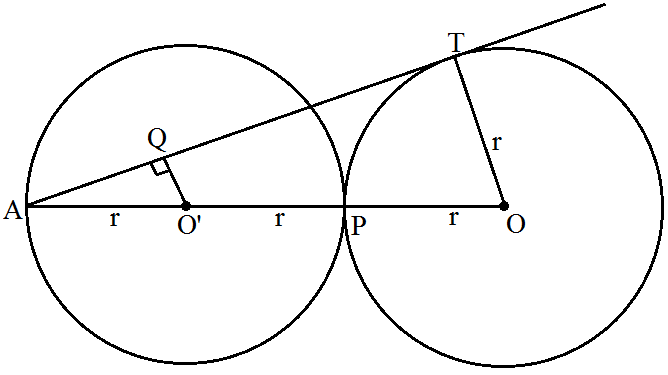
Two circles of same radii r and centres $O$ and $O'$ touch each other at $P$ as shown in. If $O O'$ is produced to meet the circle $C (O', r)$ at $A$ and $AT$ is a tangent to the circle $C (O,r)$ such that $O'Q \perp AT$. Then $AO: AO' =$
The roots of the equation $2 x^2-6 x+7=0$0 are :
Let $S_n$ denote the sum of $n$ terms of an A.P. whose first term is $a$. If the common difference $d$ is given by $d=S_n-k S_{n-1}+S_{n-2}$, then $k=$
If $16\cot\times=12,$ then $\frac{\sin\text{x}-\cos\text{x}}{\sin\text{x}+\cos\text{x}} $ equals :
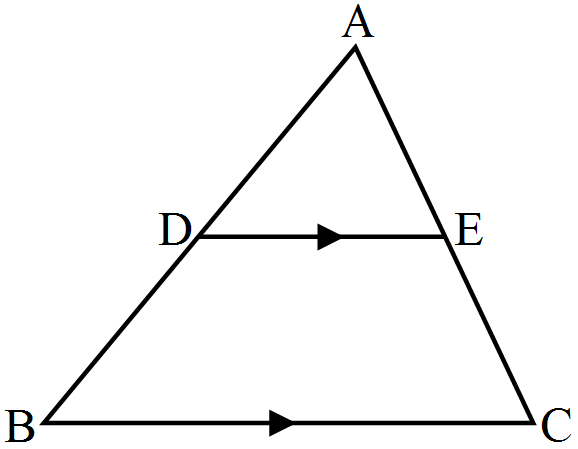
In a $\triangle\text{ABC},$ if DE is drawn parallel to BC, cutting AB and AC at D and E respectively such that AB = 7.2cm, AC = 6.4cm and AD = 4.5cm. Then, AE =?
If A(4, 2), B(6, 5) and C(1, 4) be the verteces of $\triangle\text{ABC}$ and AD is a median, then the coordinates of D are:
If $3\cos\theta=5\sin\theta,$ then the value of $\frac{5\sin\theta-2\sec^3\theta+2\cos\theta}{5\sin\theta+2\sec^3\theta-2\cos\theta}$ is: