MCQ
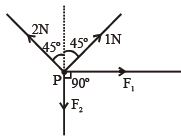
There are four forces acting at a point $P$ produced by strings as shown in figure, point $P$ is at rest. The forces $F_1$ and $F_2$ are respectively:-
  • $\frac{1}{\sqrt 2}N,\frac{3}{\sqrt 2}N$
  • B
    $\frac{3}{\sqrt 2}N,\frac{1}{\sqrt 2}N$
  • C
    $\frac{1}{\sqrt 2}N,\frac{1}{\sqrt 2}N$
  • D
    $\frac{3}{\sqrt 2}N,\frac{3}{\sqrt 2}N$
Answer

Correct option: A.
$\frac{1}{\sqrt 2}N,\frac{3}{\sqrt 2}N$
a
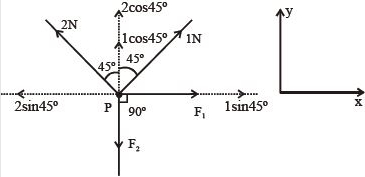
Applying equilibrium conditions, $\Sigma F_{x}=0 \quad \Rightarrow F_{1}+1 \sin 45^{\circ}-2 \sin 45^{\circ}=0$

or $F_{1}=2 \sin 45^{\circ}-1 \sin 45^{\circ}$

$=1 \sin 45^{\circ}=\frac{1}{\sqrt{2}} \mathrm{N}$

$\Sigma F_{\mathrm{y}}=0$

$\Rightarrow \mathrm{F}_{2}=1 \cos 45^{\circ}+2 \cos 45^{\circ} \Rightarrow \mathrm{F}_{2}=\frac{3}{\sqrt{2}} \mathrm{N}$

Need a full question paper?

Generate a complete, print-ready paper with questions like this in minutes — across 16+ boards, with answer keys.

Start Generating Free

Similar questions

A uniform chain of mass $m$ and length $L$ is originally placed mid-way on the top of a fixed smooth double-sided wedge (Figure- $A$). The length of each side of the wedge is $L$ . It is then given a slight push. The kinetic energy of the chain when the whole chain has just slid to the left side of the wedge (Figure- $B$), is :
Two spheres $P$ and $Q$, of same colour having radii $8\;cm$ and $2\;cm$ are maintained at temperatures ${127^o}C$ and ${527^o}C$ respectively. The ratio of energy radiated by $P$ and $Q$ is
The camera lens has an aperture of $f$ and the exposure time is $(1/60)\,s$. What will be the new exposure time if the aperture become $1.4\,f$ ?
The phase difference between the instantaneous velocity and acceleration of a particle executing simple harmonic motion is
A book is lying on the table. What is the angle between the action of the book on the table and the reaction of the table on the book ............ $^o$
$Assertion :$ A transverse waves are produced in a very long string fixed at one end. Only progressive wave is observed near the free end.
$Reason :$ Energy of reflected wave does not reach the free end.
Two rods $A$ and $B$ of identical dimensions are at temperature $30\,^oC$. If a heated upto $180\,^oC$ and $B$ upto $T\,^oC$, then the new lengths are the same. If the ratio of the coefficients of linear expansion of $A$ and $B$ is $4:3$, then the value of $T$ is........$^oC$
Heat required to convert $5\ kg$ ice at $0\ ^oC$ into water at $100\ ^oC$ is
Surface of the lake is at $2^{\circ} C$. The temperature of the bottom of the lake is ....... $^{\circ} C$
A particle moves for $8\, seconds$. It first accelerates from rest and then retards to rest. If the retardation be $3\, times$ the acceleration, then time for which it accelerates will be