Question
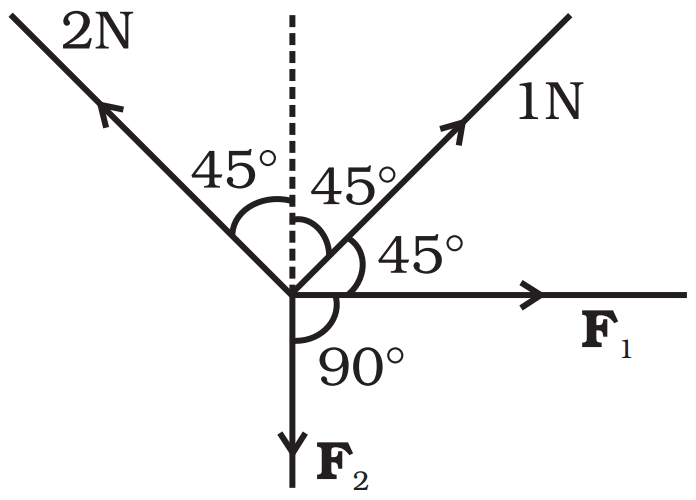
There are four forces acting at a point P produced by strings as shown in which is at rest. Find the forces $F_1$ and $F_2$.

Answer

As the particle is rest or a = 0. So resultant force due to all forces will be zero.$\therefore$ Net components along X and Y-axis will be zero.
Resolving all forces along X-axis$\text{F}_\text{x}=0$
$\text{F}_1+1\cos45^\circ-2\cos45^\circ=0$ or $\text{F}_1-1\cos45^\circ=0$
$\text{F}_1=\cos45^\circ=\frac{1}{\sqrt{2}}\frac{\sqrt{2}}{\sqrt{2}}=\frac{\sqrt{2}}{2}=\frac{1.414}{2}=0.707\text{N}$
Resolving all forces along Y-axis$\text{F}_\text{y}=0$
$-\text{F}_2+1\cos45^\circ+2\cos45%\circ=0$
$-\text{F}_2=-3\cos45^\circ$
$\text{F}_2=3.\frac{1}{\sqrt{2}}=\frac{3\sqrt{2}}{2}=\frac{3\times1.414}{2}=3\times0.707=2.121\text{N.}$

Need a full question paper?

Generate a complete, print-ready paper with questions like this in minutes — across 16+ boards, with answer keys.
Start Generating Free

Similar questions

A solid disc and a ring, both of radius 10 cm are placed on a horizontal table simultaneously, with initial angular speed equal to $10 \pi rad s ^{-1}$. Which of the two will start to roll earlier? The co-efficient of kinetic friction is $\mu_k=$
A particle executes SHM of period 8s. After what time of its passing through the mean position, will be energy be half kinetic and half potential?
The equation of motion of a particle started at t = 0 is given by $\text{x}=5\sin\big(20\text{t}+\frac{\pi}{3}\big)$ where x is in centimetre and t in second. When does the particle.
  1. First come to rest.
  2. First have zero acceleration.
  3. First have maximum speed?
The Marina trench is located in the Pacific Ocean, and at one place it is nearly eleven km beneath the surface of water. The water pressure at the bottom of the trench is about $1.1 \times 10^8$ Pa. A steel ball of initial volume $0.32m^3$ is dropped into the ocean and falls to the bottom of the trench. What is the change in the volume of the ball when it reaches to the bottom?
Show that in case of one dimensional elastic collision of two bodies, the relative velocity of separation after the collision is equal to the relative velocity of approach before the collision.
Gives the x-t plot of a particle executing one-dimensional simple harmonic motion. (You will learn about this motion in more detail in Chapter 14). Give the signs of position, velocity and acceleration variables of the particle at t = 0.3 s, 1.2 s, – 1.2 s.
i. Pick out only the vector quantities from the following: Temperature, pressure, impulse, time, power, charge.
ii. Show by drawing a neat diagram that the flight of a bird is an example of composition of vectors.
iii. A man is travelling at $10.8 km h ^{-1}$ in a topless car on a rainy day. He holds his umbrella at an angle $37^{\circ}$ to the vertical to protect himself from the rain which is falling vertically downwards. What is the velocity of the rain? $\left[\right.$ Given $\cos 37^{\circ}=\frac{4}{5}$ ]
A quarterback, standing on his opponents 35-yard line, throws a football directly down field, releasing the ball at a height of 2.00 m above the ground with an initial velocity of $20.0 m / s$, directed $30.0^{\circ}$ above the horizontal.
i. How long does it take for the ball to cross the goal line, 32.0 m from the point of release?
ii. The ball is thrown too hard and so passes over the head of the intended receiver at the goal line. What is the ball's height above the ground as it crosses the goal line?
Radiation coming from transition $n = 2$ to $n = 1$ of hydrogen atoms falls on helium ions in $n = 1$ and $n = 2$ states. What are the possible transitions of helium ions as they absorbs energy from the radiation?
An air chamber of volume V has a neck area of cross section a into which a ball of mass m just fits and can move up and down without any friction (Fig.). Show that when the ball is pressed down a little and released , it executes SHM. Obtain an expression for the time period of oscillations assuming pressure-volume variations of air to be isothermal [see Fig.].