MCQ
There are two identical vessels filled with equal amounts of ice. The vessels are of different metals., If the ice melts in the two vessels in $20$ and $35$ minutes respectively, the ratio of the coefficients of thermal conductivity of the two metals is
  • A
    $4:7$
  • $7:4$
  • C
    $16:49$
  • D
    $49:16$

Answer

Correct option: B.
$7:4$
b
(b) $Q = \frac{{KA({\theta _1} - {\theta _2})}}{l}t = $ $ \Rightarrow {K_1}{t_1} = {K_2}{t_2}$ $ \Rightarrow \frac{{{K_1}}}{{{K_2}}} = \frac{{{t_2}}}{{{t_1}}} = \frac{{35}}{{20}} = \frac{7}{4}$
(As $Q$ , $l$ , $A$ and $({\theta _1} - {\theta _2})$ are same)

Need a full question paper?

Generate a complete, print-ready paper with questions like this in minutes — across 16+ boards, with answer keys.

Start Generating Free

Similar questions

If pressure of a gas contained in a closed vessel is increased by $0.4\%$ when heated by $1°C,$ the initial temperature must be
If a hole is bored along the diameter of the earth and a stone is dropped into hole
A source of sound emits $200\pi W$ power which is uniformly distributed over a sphere of $10 m$ radius. What is the loudness of sound on the surface of a sphere
Given below are two statements : one is labelled as Assertion $A$ and the other is labelled as Reason $R$.

Assertion $A$ : When a body is projected at an angle $45^{\circ}$, it's range is maximum.

Reason $R$ : For maximum range, the value of $\sin 2 \theta$ should be equal to one.

In the light of the above statements, choose the correct answer from the options given below :

In forced oscillations, a particle oscillates simple harmonically with frequency equal to
A running man has half the kinetic energy of that of a boy of half of his mass. The man speeds up by $1\,m/s$ so as to have same K.E. as that of the boy. The original speed of the man will be
The displacement $x$ (in metre) of a particle in, simple harmonic motion is related to time t (in seconds) as

$x = 0.01\cos \left( {\pi \,t + \frac{\pi }{4}} \right)$

The frequency of the motion will be

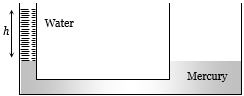
Two communicating vessels contain mercury. The diameter of one vessel is $n$ times larger than the diameter of the other. A column of water of height $ h$  is poured into the left vessel. The mercury level will rise in the right-hand vessel ($s =$ relative density of mercury and $\rho  = $ density of water) by
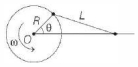
One end of a rod of length $L$ is fixed to a point on the circumference of a wheel of radius $R$. The other end is sliding freely along a straight channel passing through the centre of the wheel as shown in the figure below. The wheel is rotating with a constant angular velocity $\omega$ about $O$. Taking $T=\frac{2 \pi}{\omega}$, the motion of the rod is
The distance travelled by an object in time $t$ is given by $s =(2 \cdot 5) t ^2$. The instantaneous speed of the object at $t =5\,s$ will be $....\,ms ^{-1}$