MCQ
There are two spherical balls $A$ and $B$ of the same material with same surface, but the diameter of $A$ is half that of $B$. If $A$ and $B$ are heated to the same temperature and then allowed to cool, then
  • A
    Rate of cooling is same in both
  • B
    Rate of cooling of $A$ is four times that of $B$
  • Rate of cooling of $A$ is twice that of $B$
  • D
    Rate of cooling of $A$ is $\frac{1}{4}$ times that of $B$
Answer

Correct option: C.
Rate of cooling of $A$ is twice that of $B$
c
(c) Rate of cooling ${R_C} = \frac{{A\varepsilon \sigma ({T^4} - T_0^4)}}{{mc}}$$ = \frac{{A\varepsilon \sigma ({T^4} - T_0^4)}}{{V\rho C}}$

==> ${R_C} \propto \frac{A}{V} \propto \frac{1}{r} \propto \,\frac{1}{{({\rm{Diameter)}}}}$        $(\because \,m = \rho V)$

Since diameter of $A$ is half that of $B $ so it's rate of cooling will be doubled that of B

Need a full question paper?

Generate a complete, print-ready paper with questions like this in minutes — across 16+ boards, with answer keys.

Start Generating Free

Similar questions

Two separate wires $A$ and $B$ are stretched by $2 \,mm$ and $4\, mm$ respectively, when they are subjected to a force of $2\, N$. Assume that both the wires are made up of same material and the radius of wire $B$ is 4 times that of the radius of wire $A$. The length of the wires $A$ and $B$ are in the ratio of $a : b$. Then $a / b$ can be expressed as $1 / x$ where $x$ is
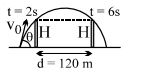
A projectile crosses two walls of equal height $H$ symmetrically as shown The maximum height of the projectile is  ........ $m$
A particle of mass $500 \,gm$ is moving in a straight line with velocity $v=b x^{5 / 2}$. The work done by the net force during its displacement from $x=0$ to $x =4 \,m$ is ...................$J$ (Take $b =0.25 \,m ^{-3 / 2} s ^{-1}$ )
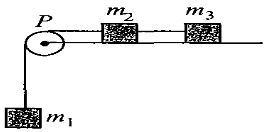
A system consists of three masses $m_1 , m_2$ and $m_3$ connected by a string passing over a pulley $P.$ The mass $m_1$ hangs freely and $m_2$ and $m_3$ are on a rough horizontal table (the coefficient of friction $= \mu ).$ The pulley is frictionless and of negligible mass. The downward acceleration of mass $m_1$ is $(Assume\, m = m_2 = m_3 = m)$ 
A soap bubble of radius $r$ has monoatomic ideal- gas inside. The gas is heated in such a manner that bubble remains in mechanical equillibrium. Assuming that the soap material of the bubble has no heat capacity, the molar heat capacity of the gas in the process will be 
(Neglect atmospheric pressure)
A moving conductor coil in a magnetic field produces an induced $e.m.f$. This is in accordance with
The magnification of an object placed in front of a convex lens of focal length $20\, cm$ is $+2$. To obtain a magnification of $-2$, the object has to be moved a distance equal to.....$cm$
A car of weight $W$ is on an inclined road that rises by $100\,m$ over a distance of $1\,Km$ and applies a constant frictional force $\frac {W}{20}$ on the car. While moving uphill on the road at a speed of  $10\,ms^{-1},$ the car needs power $P.$  If it needs power $\frac {P}{2}$ while moving down hill at speed $v$ then value of $v$ is $...... ms^{-1}$
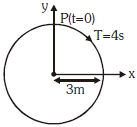
The radius of circle the period of revolution initial position and sense of revolution are indicated in the figure.

$y-$projection of the radius vector of rotating particle $\mathrm{P}$ is

Suppose a body of mass $M$ and radius $R$ is allowed to roll on an inclined plane without slipping from its topmost point $A$. , acceleration of the body down the plane is given by

($\beta  = 1 + \frac{I}{{M{R^2}}}$)