Question
‘There is a paternity dispute for a child’. Which technique can solve the problem. Discuss the principle involved.

Answer

DNA finger printing is used to solve the paternity dispute. DNA fingerprinting involves identifying differences in some specific regions in DNA sequence called as repetitive DNA, because in these sequences, a small stretch of DNA is repeated many times. These repetitive DNA are separated from bulk genomic DNA as different peaks during density gradient centrifugation.The bulk DNA forms a major peak and the other small peaks are referred to as satellite DNA. Depending on base composition (A : T rich or G : C rich), length of segment, and number of repetitive units, the satellite DNA is classified into many categories, such as micro-satellites, mini-satellites etc. These sequences normally do not code for any proteins, but they form a large portion of human genome.
These sequence show high degree of polymorphism and form the basis of DNA fingerprinting. Since DNA from every tissue (such as blood, hair-follicle, skin, bone, saliva, sperm etc.), from an individual show the same degree of polymorphism, they become very useful identification tool in forensic applications. Further, as the polymorphisms are inheritable from parents to children, DNA fingerprinting is the basis of paternity testing, in case of disputes.
The technique of DNA fingerprinting was initially developed by Alec Jeffreys. Lalji Singh is called father of Indian DNA fingerprinting or DNA profiling or DNA typing. He used a satellite DNA as probe that shows very high degree of polymorphism. It was called as Variable Number of Tandem Repeats (VNTR).
The technique, as used earlier, involved Southern blot hybridisation using radiolabelled VNTR as a probe. It included,
  1. Isolation of DNA.
  2. Digestion of DNA by restriction endonucleases.
  3. Separation of DNA fragments by electrophoresis.
  4. Transferring (blotting) of separated DNA fragments to synthetic membranes, such as nitrocellulose or nylon.
  5. Hybridisation using labelled VNTR probe.
  6. Detectionof hybridised DNA fragments by autoradiography.
Need a full question paper?

Generate a complete, print-ready paper with questions like this in minutes — across 16+ boards, with answer keys.

Start Generating Free

Similar questions

“Maintenance of personal and public hygiene is necessary for prevention and control of many infectious diseases”. Justify the statement giving suitable examples.
Name the law that states that the sum of allelic frequencies in a population remains constant. What are the five factors that influence these values?
Answer the following questions:
Explain Polygenic inheritance and Multiple allelism with the help of suitable examples.
Vicky's mother was using the same mosquito repellent cream from last six years. She was regularly complaining that this cream has no effects on mosquitoes now. Hearing this, Vicky advised his mother to change the cream as regular usage has led the mosquitoes to develop resistance against it. His mother changed the cream and could notice its effect on mosquitoes.
  1. Explain how mosquitoes were not affected by the previous cream?
  2. On what factors, Darwin's theory was based?
  3. Can you relate this incident to Darwin's concept? How?
  4. Identify the values shown by Vicky.
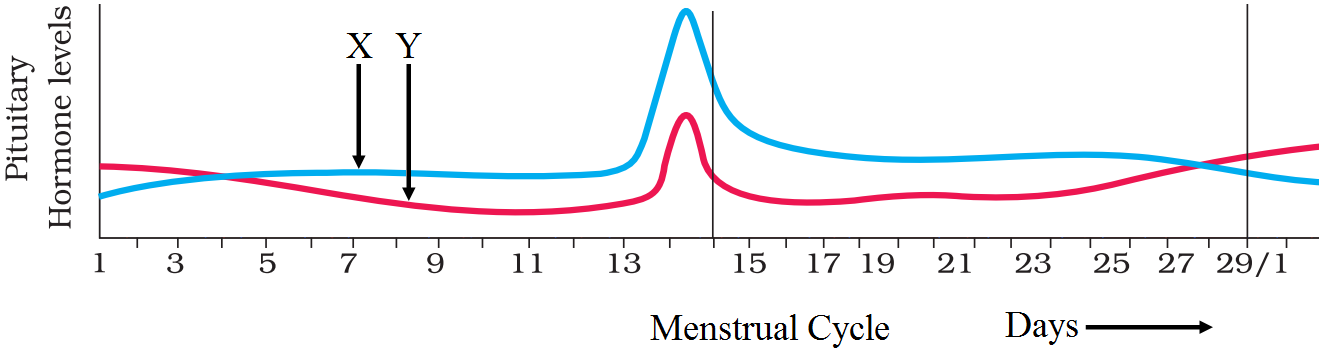
Study the graph given below and answer the questions that follow:
Name the hormones ‘X’ and ‘Y’.
Enumerate the points that have to be considered for successful bee-keeping.
Describe in detail the multiple allelism by the help of inheritance of human blood group.
Briefly mention the contribution of T.H. Morgan in genetics.
You are given a red flower–bearing pea plant and a red flower–bearing snapdragon plant. How would you find the genotypes of these two plants with respect to the colour of the flower? Explain with the help of crosses. Comment upon the pattern of inheritance seen in these two plants.
Write a short note on uterus.