MCQ
There is no $S - S$ bond in
- A${S_2}O_4^{2 - }$
- B${S_2}O_5^{2 - }$
- C${S_2}O_3^{2 - }$
- ✓${S_2}O_7^{2 - }$
$\begin{array}{*{20}{c}}
{O\,\,\,\,\,\,\,\,\,\,\,\,\,\,O} \\
{|\,|\,\,\,\,\,\,\,\,\,\,\,\,\,\,\,\,|\,|} \\
{{}^ - O - S - O - S - {O^ - }} \\
{|\,|\,\,\,\,\,\,\,\,\,\,\,\,\,\,\,|\,|} \\
{O\,\,\,\,\,\,\,\,\,\,\,\,O}
\end{array}$
Generate a complete, print-ready paper with questions like this in minutes — across 16+ boards, with answer keys.
$l$ $m$
$(a)$ The $pH$ of a mixture containing $400\, mL$ of $0.1\, M\, H_2SO_4$ and $400\, mL$ of $0.1\, M\, NaOH$ will be approximately $1.3$.
$(b)$ Ionic product of water is temperature dependent.
$(c)$ A monobasic acid with $K_a = 10^{-5}$ has a $pH = 5$. the degree of dissociation of this acid is $50\%$.
$(d)$ The Le Chatelier’s principle is not applicable to common-ion effect.
The correct statements are:
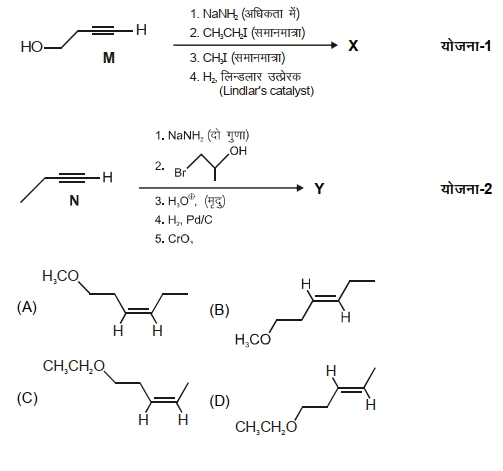
$1.$ The product $X$ is
mcq $Image$
$2.$ The correct statement with respect to product $Y$ is :
$(A)$ It gives a positive Tollens test and is a functional isomer of $X$.
$(B)$ It gives a positive Tollens test and is a geometrical isomer of $X$.
$(C)$ It gives a positive iodoform test and is a functional isomer of $X$.
$(D)$ It gives a positive iodoform test and is a geometrical isomer of $X$.
Give the answer question $1$ and $2.$