MCQ
There will be decrease in potential energy of the system, if work is done upon the system by
  • A
    Any conservative or non-conservative force
  • B
    A non-conservative force
  • A conservative force
  • D
    None of the above

Answer

Correct option: C.
A conservative force
c
(c) Potential energy will increase when work is done by the system against a conservative force.

Need a full question paper?

Generate a complete, print-ready paper with questions like this in minutes — across 16+ boards, with answer keys.
Start Generating Free

Similar questions

If $‘M’$ is the mass of water that rises in a capillary tube of radius $‘r’,$ then mass of water which will rise in a capillary tube of radius $‘2r’$ is
A stone of mass $1\, kg$ tied to a light inextensible string of length $L = \frac{{10}}{3}m$ is whirling in a circular path of radius $L$ in a vertical plane. If the ratio of the maximum tension in the string to the minimum tension in the string is $4$ and if $g$ is taken to be $10m/{\sec ^2}$, the speed of the stone at the highest point of the circle is ....... $m/\sec$
A water heater of power $2000\,W$ is used to heat water. The specific heat capacity of water is $4200\,J\,kg ^{-1}\, K ^{-1}$. The efficiency of heater is $70 \%$. Time required to heat $2\,kg$ of water from $10^{\circ}\,C$ to $60^{\circ}\,C$ is $..........s$. (Assume that the specific heat capacity of water remains constant over the temperature range of the water).
Steel wire of length ' $L$ ' at $40^{\circ} C$ is suspended from the ceiling and then a mass ' $m$ ' is hung from its free end. The wire is cooled down from $40^{\circ} C$ to $30^{\circ} C$ to regain its original length ' $L$ '. The coefficient of linear thermal expansion of the steel is $10^{-5} /{ }^{\circ} C$, Young's modulus of steel is $10^{11} N / m ^2$ and radius of the wire is $1 \ mm$. Assume that $L \gg$ diameter of the wire. Then the value of ' $m$ ' in $kg$ is nearly
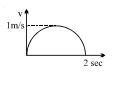
Velocity-time graph for a car is semicircle as shown here. Which of the following is correct :
The speed of a wave produced in water is given by $v=\lambda^a g^b \rho^c$. Where $\lambda$, g and $\rho$ are wavelength of wave, acceleration due to gravity and density of water respectively. The values of $a , b$ and $c$ respectively, are
Let $\overrightarrow{\text{A}}$ be a unit vector along the axis of rotation of a purely rotating body and $\overrightarrow{\text{B}}$ be a unit vector along the velocity of a particle P of the body away from the axis. The value of $\overrightarrow{\text{A}}.\overrightarrow{\text{B}}$ is:
$40$ calories of heat is needed to raise the temperature of $1\, mole$ of an ideal monoatomic gas from $20°C$ to $30°C$ at a constant pressure. The amount of heat required to raise its temperature over the same interval at a constant volume $(R = 2\,calorie\,mol{e^{ - 1}}{K^{ - 1}})$ is  ..... $calorie$
The potential energy function (in J) of a particle in a region of space is given as $U=\left(2 x^2+3 y^3+2 z\right)$. Here $\mathrm{x}, \mathrm{y}$ and $\mathrm{z}$ are in meter. The magnitude of $\mathrm{x}$ - component of force (in $\mathrm{N}$ ) acting on the particle at point $\mathrm{P}(1,2,3)\ \mathrm{m}$ is:
Two simple pendulums of length $0.5\, m$ and $2.0\, m$ respectively are given small linear displacement in one direction at the same time. They will again be in the phase when the pendulum of shorter length has completed .... oscillations.