MCQ
Thermal capacity of a body depends on
  • A
    Heat given
  • B
    The temperature raised
  • The mass of body
  • D
    None

Answer

Correct option: C.
The mass of body
c
The thermal capacity of an object, is defined as the Energy in Joules required to raise the temperature of a given object by $1^{\circ} \mathrm{C}$. This is the 'specific heat' of the object multiplied by its mass and the change in temperature

Need a full question paper?

Generate a complete, print-ready paper with questions like this in minutes — across 16+ boards, with answer keys.
Start Generating Free

Similar questions

If the percentage errors in measuring the length and the diameter of a wire are $0.1 \%$ each. The percentage error in measuring its resistance will be:
Which of the following quantities is dimensionless
Two moles of ideal helium gas are in a rubber balloon at $30^o C$. The balloon is fully expandable and can be assumed to required no energy in its expansion. The temperature of the gas in the balloon is slowly changed to $35^o C$. The amount of heat required in raising the temperature is nearly...... $J$
(take $R$ $=$ $8.31$ $J/mol.K$)
A gun is aimed at a target in a line of its barrel. The target is released and allowed to fall under gravity at the same instant the gun is fired. The bullet will
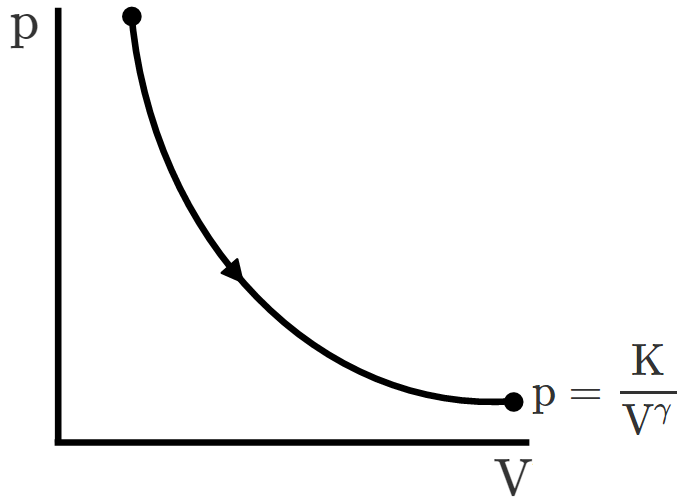
The molar heat capacity for the process shown in the figure is:
  1. C = Cp
  2. C = Cv
  3. C > Cv
  4. C = 0

Consider two observers moving with respect to each other at a speed v along a straight line. They observe a bock of mass m moving a distancel on a rough surface. The following quantities will be same as observed by the two observers.
At the top of the trajectory of a projectile, the acceleration is
A gas at ${27}^\circ C$ temperature and $30$ atmospheric pressure is allowed to expand to the atmospheric pressure. If the volume becomes $10$ times its initial volume, then the final temperature becomes ...... $^oC$
If the pressure of an ideal gas contained in a closed vessel is increased by $0.5\%,$ the increase in temperature is $2K.$ The initial temperature of the gas is ...... $^oC$
The function $sin^2\,(\omega t)$ represents