MCQ
Thermal expansion of a solid is due to the
  • A
    symmetric characteristic of the inter atomic potential energy curve of the solid
  • asymmetric characteristic of the inter atomic potential energy curve of the solid
  • C
    double well nature of the inter atomic potential energy curve of the solid
  • D
    rotational motion of the atoms of the solid

Answer

Correct option: B.
asymmetric characteristic of the inter atomic potential energy curve of the solid
b
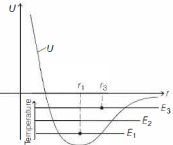
$(b)$ An approximate potential energy curve for two particles is as shown below.

Here $E_1, E_2$ and $E_3$ are the total energy values of particles. As temperature increases, total energy $E$ increases.

Hence, mean separation $r$ also increases.

Note 'That mean separation $r$ is mid point of length of $E$ intercepted by potential energy curve.

Need a full question paper?

Generate a complete, print-ready paper with questions like this in minutes — across 16+ boards, with answer keys.

Start Generating Free

Similar questions

Consider the motion of a positive point charge in a region where there are simultaneous uniform electric and magnetic fields $\vec{E}=E_0 \hat{j}$ and $\vec{B}=B_0 \hat{j}$. At time $t=0$, this charge has velocity $\nabla$ in the $x$-y plane, making an angle $\theta$ with $x$-axis. Which of the following option$(s)$ is(are) correct for time $t>0$ ?

$(A)$ If $\theta=0^{\circ}$, the charge moves in a circular path in the $x-z$ plane.

$(B)$ If $\theta=0^{\circ}$, the charge undergoes helical motion with constant pitch along the $y$-axis.

$(C)$ If $\theta=10^{\circ}$, the charge undergoes helical motion with its pitch increasing with time, along the $y$-axis.

$(D)$ If $\theta=90^{\circ}$, the charge undergoes linear but accelerated motion along the $y$-axis.
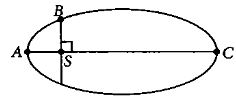
The kinetic energies of a planet in an elliptical orbit about the Sun, at positions $A, B$ and $C$ are   $K_A, K_B$ and $K_C$, respectively. $AC$ is the major axis and $SB$ is perpendicular to $AC$ at the position of the Sun $S$ as shown in the figure. Then
Two particles of masses ${m_1}$ and ${m_2}$ in projectile motion have velocities ${\vec v_1}$ and ${\vec v_2}$ respectively at time $t = 0$. They collide at time ${t_0}$. Their velocities become ${\vec v_1}'$ and ${\vec v_2}'$ at time $2{t_0}$ while still moving in air. The value of $|({m_1}\overrightarrow {{v_1}} '\, + {m_2}\overrightarrow {{v_2}} ') - ({m_1}\overrightarrow {{v_1}} \, + {m_2}\overrightarrow {{v_2}} )$| is
The instantaneous values of alternating current and voltages in a circuit are given as 

$ I= \frac{1}{{\sqrt 2 }} sin \left( {100\pi t} \right)$  

$E=\frac{1}{\sqrt{2}} \sin (100 \pi t+\pi / 3)$

The average power in watts consumed in the circuit is

Two short magnets placed along the same axis with their like poles facing each other repel each other with a force which varies inversely as
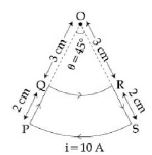
A current loop, having two circular arcs joined by two radial lines is shown in the figure. It carries a current of $10\, A$. The magnetic field at point $O$ will be close to
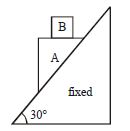
In the given figure acceleration of wedge $'A'$ is $10\ m/s^2$ along the inclined plane. (There is no friction between $A$ $\&$ $B$ and $A$ $\&$ fixed inclined plane.) Then acceleration of block $'B'$ will ............ $m/s^2$
Why it is more hotter for same distance over the top of a candle than it in the side of its flame?
Two simple pendulums having lengths $l_{1}$ and $l_{2}$ with negligible string mass undergo angular displacements $\theta_{1}$ and $\theta_{2}$, from their mean positions, respectively. If the angular accelerations of both pendulums are same, then which expression is correct?
A spherical conductor of radius $2m$ is charged to a potential of $120\, V$. It is now placed inside another hollow spherical conductor of radius $6m$. Calculate the potential to which the bigger sphere would be raised......$V$