MCQ
Thermal neutrons are those which
  • A
    Are at very high temperature
  • B
    Move with high velocities
  • Have kinetic energies similar to those of surrounding molecules
  • D
    Are at rest

Answer

Correct option: C.
Have kinetic energies similar to those of surrounding molecules
c
(c) When fast moving neutrons pass through a moderator, they collide with the molecules of the moderator.

As a result of this the neutrons are in thermal equilibrium with the surrounding molecules of moderator.

These neutrons are called thermal neutrons.

Need a full question paper?

Generate a complete, print-ready paper with questions like this in minutes — across 16+ boards, with answer keys.
Start Generating Free

Similar questions

At a temperatur of $30\,^oC$, the susceptibility of a ferromagnetic material is found to be $\chi $ . Its susceptibility at $333\,^oC$ is....$\chi $
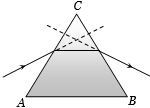
In the given figure, what is the angle of prism
In Young’s double slit experiment, the distance between the two slits is made half, then the fringe width will become
$Assertion :$ Mean free path of a gas molecules varies inversely as density of the gas.
$Reason :$ Mean free path varies inversely as pressure of the gas.
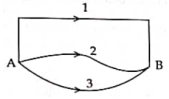
A gravitational field is present in a region and a mass is shifted from $A$ to $B$ through different paths as shown. If $W _1, W _2$ and $W _3$ represent the work done by the gravitational force along the respective paths, then
In a plane electromagnetic wave, which of the following has/ have zero average/value in one complete cycle?

$(a)$ Magnetic field

$(b)$ Magnetic energy

$(c)$ Electric field

$(d)$ Electric energy

A dip circle lies initially in the magnetic meridian, it shows an angle of dip $\delta$ at a place. The dip circle is rotated through an angle $\alpha$ in the horizontal plane and then it shows an angle of dip $\delta^{\prime}$. Hence $\frac{\tan \delta^{\prime}}{\tan \delta}$ is
If the polarising angle for air glass interface is $56.3^o$, what is the angle of refraction in glass ?
A ray of ligh is incident at an angle of incidence $60^{\circ}$ on the glass slab of refractive index $\sqrt{3}$. After refraction, the light ray emerges out from other parallel faces and lateral shift between incident ray and emergent ray is $4 \sqrt{3} \,cm$. The thickness of the glass slab is. . .  .. . $cm$.
If $x = a -b,$ then percentage error in $x$ will be