MCQ
Thermal neutrons are those which
  • A
    Are at very high temperature
  • B
    Move with high velocities
  • Have kinetic energies similar to those of surrounding molecules
  • D
    Are at rest

Answer

Correct option: C.
Have kinetic energies similar to those of surrounding molecules
c
(c) When fast moving neutrons pass through a moderator, they collide with the molecules of the moderator.

As a result of this the neutrons are in thermal equilibrium with the surrounding molecules of moderator.

These neutrons are called thermal neutrons.

Need a full question paper?

Generate a complete, print-ready paper with questions like this in minutes — across 16+ boards, with answer keys.
Start Generating Free

Similar questions

A galvanometer of resistance, $G,$ is shunted by a resistance $S$ $ohm$. To keep the main current in the circuit unchanged, the resistance to be put in series with the galvanometer is
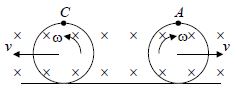
Two metallic rings of radius $R$ are rolling on a metallic rod. $A$ magnetic field of magnitude $B$ is applies in the region. The magnitude of potential difference between point $A$ and point $C$ on the two rings (as shown), will be :-
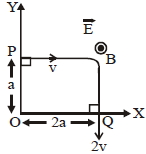
A charged particle of mass $\mathrm{m}$ and charge $q$ moving under the influence of uniform electric field $E\hat{i }$ and a uniform magnetic field $B\hat{k}$ follows a trajectory from point $\mathrm{P}$ to $\mathrm{Q}$ as shown in figure. The velocities at $P$ and $Q$ are respectively, $v\hat i$ and $-2 v \hat j$. Then which of the following statements $(\mathrm{A}, \mathrm{B}, \mathrm{C}, \mathrm{D})$ are the correct $?$ (Trajectory shown is schematic and not to scale)

$(A)$ $\mathrm{E}=\frac{3}{4}\left(\frac{\mathrm{mv}^{2}}{\mathrm{qa}}\right)$

$(B)$ Rate of work done by the electric field at $\mathrm{P}$ is $\frac{3}{4}\left(\frac{\mathrm{mv}^{3}}{\mathrm{a}}\right)$

$(C)$ Rate of work done by both the fields at $\mathrm{Q}$ is zero

$(D)$ The difference between the magnitude of angular momentum of the particle at $\mathrm{P}$ and $Q$ is $2 mav$.
A wavefront presents one, two and three HPZ at points A, B and C respectively. If the ratio of consecutive amplitudes of HPZ is 4 : 3, then the ratio of resultant intensities at these point will be
Which of the following cannot be seen by a microscope?
A thin rod of length$f/3$ lies along the axis of a concave mirror of focal length $f.$ One end of its magnified image touches an end of the rod. The magnification of the image is
$A$ concave mirror is used to form image of the Sun on a white screen. If the lower half of the mirror were covered with an opaque card, the effect on the image on the screen would be
In Balmer series of emission spectrum of hydrogen, first four lines with different wavelength $\text{H}\alpha $ $ \text{H}\beta$ $\text{H}\gamma$ and $\text{H}\delta$ are obtained. Which line has maximum frequency out of these?
If $10\%$ of a radioactive material decays in $5\, days$ then the amount of the original material left after $20\, days$ is approximately .......... $\%$
Assertion : $90_{\mathrm{Sr}}$ from the radioactive fall out from a nuclear bomb ends up in the bones of human beings through the milk consumed by them. It causes impairment of the production of red blood cells.
Reason : The energetics b-particles emitted in the decay of $90_{\mathrm{Sr}}$ damage the bone marrow.