Question
Things to keep in mind to get the image formed by the lens.

Answer

→To find the image of an object by a lens, we can, in principal, take any two rays emanating from a point on an object, trace their paths using the laws of refraction and find the point where the refracted rays meet (or appear to meet). In practice, however, it is convenient to choose any two of the following rays:
Image
Image
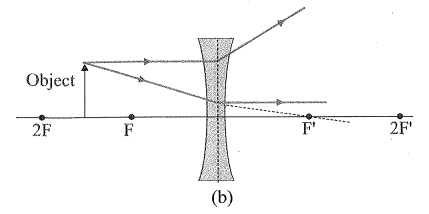
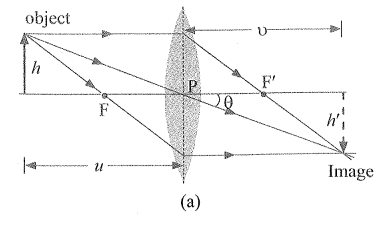
(i) A ray emanating from the object parallel to the principle axis of the lens after refraction passes through the second principal focus (in a convex lens) or appears to diverge (in a concave lens) from the first principal focus.
(ii) A ray of light, passing through the optical centre of the lens, emerges without any deviation after refraction.
(iii) A ray of light passing through the first principal focus of a convex lens (or appearing to meet principal axis at second focus point of a concave lens) emerges parallel to the principal axis after refraction.
→Figure (a) and (b) illustrate these rules for a convex and a concave lens.
Need a full question paper?

Generate a complete, print-ready paper with questions like this in minutes — across 16+ boards, with answer keys.

Start Generating Free

Similar questions

The separation between the consecutive dark fringes in a Young's double slit experiment is 1.0mm. The screen is placed at a distance of 2.5m from the slits and the separation between the slits is 1.0mm. Calculate the wavelength of light used for the experiment.
Two identical phase connected waves, each of intensity $I _0$, are producing interference patterns. Write the value of the resultant intensity at the places of (i) constructive interference, (ii) destructive interference
A current of 10A is established in a long wire along the positive z-axis. Find the magnetic field $\overrightarrow{\text{B}}$ at the point (1m, 0, 0).
If two quantities have same dimensions, do they represent same physical content?
Suppose the tube in the previous problem is kept vertical with A upward but the other conditions remain the same. The separation between the cross- sections at A and B is $\frac{15}{16}\text{cm}.$ Repeat parts (a), (b) and (c) of the previous problem. Take g = 10m/s2.
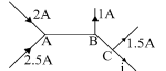
Calculate the value of $i$ as shown in the figure.
Image
A parallel plate capacitor made of circular plates each of radius R = 6.0 cm has a capacitance C = 100 pF. The capacitor is connected to a 230 V ac supply with a (angular) frequency of 300 rad s-1.
  1. What is the rms value of the conduction current?
  2. Is the conduction current equal to the displacement current?
  3. Determine the amplitude of B at a point 3.0 cm from the axis between the plates.
The refractive index of a material is. What is the angle of refraction if the unpolarised light is incident on it at the polarising angle of the medium?
What is linear magnification? Obtain equation of linear magnification for mirror.
A pendulum having time period equal to two seconds is called a seconds pendulum. Those used in pendulum clocks are of this type. Find, the length of a seconds pendulum at a place where $\text{g}=\pi^2\text{m/s}^2.$