MCQ
This conversion can be achieved by
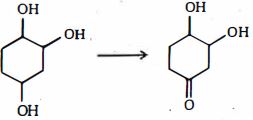
  • A
    $Me_2CO/H^+ , H_3O^{\oplus} , KMnO_4/HO^-$
  • $Me_2CO/H^+ , KMnO_4 , H_3O^+$
  • C
    $KMnO_4 /NaO_4 , Me_2CO/H^+ , H_3O^+$
  • D
    $KMnO_4 /NaIO_4 , H_3O^+ , Me_2CO/H^+$

Answer

Correct option: B.
$Me_2CO/H^+ , KMnO_4 , H_3O^+$
b

Need a full question paper?

Generate a complete, print-ready paper with questions like this in minutes — across 16+ boards, with answer keys.
Start Generating Free

Similar questions

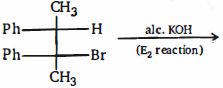
What is the major product of the following reaction ?
In E2​ elimination some compounds follow Hofmann's rule which means:

Spin only magnetic moment in $BM$ of $\left[\mathrm{Fe}(\mathrm{CO})_{4}\left(\mathrm{C}_{2} \mathrm{O}_{4}\right)\right]^{+}$ is
The standard potential of a $Co^{+2}\,|\, Co$ electrode is $-0.28\, V$ and the standard potential of the cell $Pt\,|\,T{i^{2 + }}\left( {aq.} \right),\,T{i^{3 + }}\left( {aq.} \right)\,||\,C{o^{2 + }}\left( {aq.} \right)\,|\,Co\left( s \right)$ is $0.09\,V$. what is the standard potential of the $Ti_{\left( {aq.} \right)}^{2 + }\,|Ti_{\left( {aq.} \right)}^{3 + }$ electrode ........... $\mathrm{V}$
Which of the following halogen does not exhibit positive oxidation state in its compounds
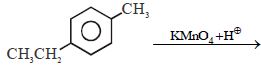
Major product of the reaction is
The electric conduction of a salt solution in water depends on the
What is final product $(IV)$ in the sequence of $\begin{matrix}
   C{{H}_{3}}-CH-OH\xrightarrow{PB{{r}_{3}}}I\xrightarrow{Mg/ether}  \\
   \,\,\,\,|\,\,\,\,\,\,\,\,\,\,\,\,\,\,\,\,\,\,\,\,\,\,\,\,\,\,\,\,\,\,\,\,\,\,\,\,\,\,\,\,\,\,\,\,\,\,\,\,\,\,\,  \\
   C{{H}_{3}}\,\,\,\,\,\,\,\,\,\,\,\,\,\,\,\,\,\,\,\,\,\,\,\,\,\,\,\,\,\,\,\,\,\,\,\,\,\,\,\,\,  \\
\end{matrix}$ $II\,\xrightarrow{{\begin{array}{*{20}{c}}
  {C{H_2} - C{H_2}} \\ 
  \begin{subarray}{l} 
  \backslash / \\ 
  O 
\end{subarray}  
\end{array}}}III\,\xrightarrow{{{H_2}O}}IV$
What may be expected to happen when phosphine gas is mixed with chlorine gas
$C{H_3}C{H_2}OH\xrightarrow{{\operatorname{Re} dP + {I_2}}}\left( A \right)\xrightarrow[{Ether}]{{Mg}}\left( B \right)\xrightarrow{{HCHO}}\left( C \right)\xrightarrow{{{H_2}O}}\left( D \right)$

The compound $(D)$ is