MCQ
This question has a paragraph followed by two statements, Statement $- 1$ and Statement $- 2$. Of the given four alternatives after the statements, choose the one that describes the statements.
A thin air film is formed by putting the convex surface of a plane-convex lens over a plane glass plate. With monochromatic light, this film gives an interference pattern due to light reflected from the top ( convex) surface and the bottom (glass plate) surface of the film.
Statement $- 1$ : When light reflects from the air-glass plate interface, the reflected wave suffers a phase change of $\pi$.
Statement $- 2$ : The centre of the interference pattern is dark.
  • A
    Statement$- 1$ is true, Statement$-2$ is true, Statement$- 2$ is the correct explanation of Statement $- 1.$
  • Statement$- 1$ is true, Statement$-2$ is true, Statement$- 2$ is not the correct explanation of Statement $- 1.$
  • C
    Statement $- 1$ is false, Statement $-2$ is true.
  • D
    Statement$- 1$ is true, Statement$-2$ is false
Answer

Correct option: B.
Statement$- 1$ is true, Statement$-2$ is true, Statement$- 2$ is not the correct explanation of Statement $- 1.$
b
A phase change of $\pi $ rad appears when the ray reflects at the glass - air interface. Also, the centre of the interference pattern is dark.

Need a full question paper?

Generate a complete, print-ready paper with questions like this in minutes — across 16+ boards, with answer keys.

Start Generating Free

Similar questions

According to classical physics, $10^{-15}\ m$ is distance of closest approach $(d_c)$ for fusion to occur between two protons. A more accurate and quantum approach says that ${d_c} = \frac{{{\lambda _p}}}{{\sqrt 2 }}$ where $'\lambda _p'$ is de-broglie's wavelength of proton when they were far apart. Using quantum approach, find equation of temperature at centre of star. [Given: $M_p$ is mass of proton, $k$ is boltzman constant]
Of the two bulbs in a house hold circuit, one glows brighter than the other, Which of the two bulbs has a large resistance?
A long solenoid of radius $2\, cm$ has $100\, turns/cm$ and carries a current of $5\,A$. A coil of radius $1\, cm$ having $100\, turns$ and a total resistance of $20\,\Omega $ is placed inside the solenoid coaxially. The coil is connected to a galvanometer. If the current in the solenoid is reversed in direction, find the charge flown through the galvanometer
Two identical charged spheres are suspended by strings of equal lengths. The strings make an angle of $30^{\circ}$ with each other. When suspended in a liquid of density $0.8 \;g\, cm ^{-3}$, the angle remains the same. If density of the material of the sphere is $1.6\; g \,cm ^{-3}$, the dielectric constant of the liquid is
A coil of inductance $40 \,henry$ is connected in series with a resistance of $8\,\Omega$ and the combination is joined to the terminals of a $2\,volt$ battery. The time constant of the circuit is......$seconds$
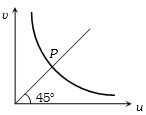
The graph shows variation of $ v$ with change in $ u $ for a mirror. Points plotted above the point $P$ on the curve are for values of $v$
A wheel is rotating about an axis through its centre at $720\, rpm$. It is acted on by a constant torque opposing its motion for $8\, seconds$ to bring it to rest finally. The value of torque (in $N-m$) is  (Given $I = \frac{{24}}{\pi }kg - {m^2}$ )
This question has Statement $1$ and Statement $2$. Of the four choices given after the Statements, choose the one that best describes the two Statements.

If two springs $S_1$ and $S_2$ of force constants $k_1$ and $k_2$, respectively, are stretched by the same force, it is found that more work is done on spring $S_1$ than on spring $S_2$.
STATEMENT 1 : If stretched by the same amount work
done on $S_1$, Work done on $S_1$ is more than $S_2$
STATEMENT2: $k_1 < k_2$

The position of a body moving along $x$-axis at time $t$ is given by $x=\left(t^2-4 t+6\right) m$. The distance travelled by body in time interval $t=0$ to $t=3 \,s$ is ...... $m$
If the height of transmitting and receiving antennas are $80\,m$ each, the maximum line of sight distance will be $..............\,km$

Given : Earth's radius $=6.4 \times 10^6 m$.