MCQ
This question has Statement $1$ and Statement $2.$ Of the four choices given after the Statements, choose the one that best describes the two Statements.

Statement $1 :$ An inventor claims to have constructed an engine that has an efficiency of $30\%$ when operated between the boiling and freezing points of water. This is not possible.

Statement $2:$ The efficiency of a real engine is always less than the efficiency of a Carnot engine operating between the same two temperatures.

  • A
    Statement $1$ is true, Statement $2$ is true,

    Statement $2$ is not the correct explanation of Statement $1.$

  • B
    Statement l is true, Statement 2 is false .
  • C
    Statement $1$ is false, Statement $2$ is true.
  • Statement $1$ is true, Statement $2$ is true,

    Statement $2$ is the correct explanation of Statement $1.$
Answer

Correct option: D.
Statement $1$ is true, Statement $2$ is true,

Statement $2$ is the correct explanation of Statement $1.$
d
According to Carnot's theorem $-$ no heat engine working between two given temperatures of source and sink can be more efficient than a perfectly reversible engine i.e. Carnot engine working between the same two temperatures.

Efficiency of Carnot's engine, $n=1-\frac{T_{2}}{T_{1}}$

$ where, T_{1}= temperature \,of\, source $

$T_{2}= temperature of \sin k$

Need a full question paper?

Generate a complete, print-ready paper with questions like this in minutes — across 16+ boards, with answer keys.

Start Generating Free

Similar questions

The efficiency of the heat engine:
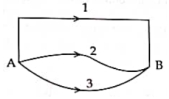
A gravitational field is present in a region and a mass is shifted from $A$ to $B$ through different paths as shown. If $W _1, W _2$ and $W _3$ represent the work done by the gravitational force along the respective paths, then
A solid sphere, a solid cylinder, a disc and a ring are rolling down an inclined plane. Which of these bodies will reach the bottom simultaneously
The planes of two rigid discs are perpendicular to each other. They are rotating about their axes. If their angular velocities are $3 \,rad/sec$ and $4\, rad/sec$ respectively, then the resultant angular velocity of the system would be ........ $rad/sec$
The pressure and temperature of an ideal gas in a closed vessel are $720\, kPa$ and $40^oC$ respectively. If $\frac{1}{4}^{th}$ of the gas is released from the vessel and the temperature of the remaining gas is raised to $353^oC,$ the final pressure of the gas is ....... $kPa$
A ball is moving uniformly in a circular path of radius $1 m$ with a time period of $1.5 \,s$. If the ball is suddenly stopped at $t=8.3 \,s$, the magnitude of the displacement of the ball with respect to its position at $t=0 \,s$ is closest to .......... $m$
A system consists of two types of gas molecules $A$ and $B$ having same number density $2 \times$ $10^{25}\, / {m}^{3}$. The diameter of ${A}$ and ${B}$ are $10\, \stackrel{\circ}{{A}}$ and $5\, \stackrel{\circ}{{A}}$ respectively. They suffer collision at room temperature. The ratio of average distance covererd by the molecule $A$ to that of $B$ between two successive collision is $.....\,\times 10^{-2}$
The moment of inertia of semicircular ring about an axis, passing through the center and perpendicular to the plane of ring, is $\frac{1}{ x } MR ^2$, where $R$ is the radius and $M$ is the mass of semicircular ring. The value of $x$ will be $...........$
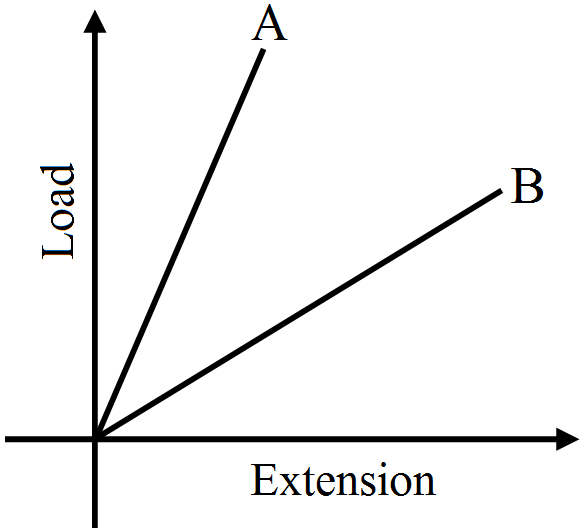
In the given figure, if the dimension of the wire are the same and materials are different, Young's modulus is more for:

A gas in container $A$ is in thermal equilibrium with another gas in container $B.$ both contain equal masses of the two gases in the respective containers. Which of the following can be true