MCQ
Thomas slag is
  • $C{a_3}{(P{O_4})_2}$
  • B
    $MnSi{O_3}$
  • C
    $CaSi{O_3}$
  • D
    $FeSi{O_3}$

Answer

Correct option: A.
$C{a_3}{(P{O_4})_2}$
a
It’s Obvious.

Need a full question paper?

Generate a complete, print-ready paper with questions like this in minutes — across 16+ boards, with answer keys.

Start Generating Free

Similar questions

Phenolphthalein does not act as an indicator for the titration between
To support tungstun filament in electric bulb, the steel used is
Bond order is a concept in the molecular orbital theory. It depends on the number of electrons in the bonding and antibonding orbitals. Which of the following statements is true about it ? The bond order
Product of the reaction is
The concentration of $KI $ and $KCl$  in certain solution containing both is $0.001\,M $ each. If $20 \,ml$  of this solution is added to $20 \,ml $ of a saturated solution of $AgI $ in water? What will happen
Consider two reactions

$I.$  $Zn +$ conc. $HNO_3$ (hot) $\rightarrow Zn(NO_3)_2 + X + H_2O$

$II.$  $Zn +$ dil. $HNO_3$ (cold) $\rightarrow Zn(NO_3)_2 + Y + H_2O$

Compounds $X$ and $Y$ are respectively

$(i)\,\,\begin{matrix}
   CHO\,\,\,\,\,\,\,\,\,\,\,\,\,\,\,\,\,\,\,\,\,  \\
   |\,\,\,\,\,\,\,\,\,\,\,\,\,\,\,\,\,\,\,\,\,\,\,\,\,\,\,\,\,\,\,  \\
   {{(CH-OH)}_{3}}\,\,\,\,\,\,  \\
   |\,\,\,\,\,\,\,\,\,\,\,\,\,\,\,\,\,\,\,\,\,\,\,\,\,\,\,\,\,\,\,  \\
   \,\,C{{H}_{2}}-OH\,\,\,\,\,\,\,\,\,\,  \\
\end{matrix}\xrightarrow{4HI{{O}_{4}}} Product$ $(ii)\,\,\begin{matrix}
   C{{H}_{2}}OH\,\,\,\,\,\,\,\,\,\,\,\,\,\,\,\,  \\
   |\,\,\,\,\,\,\,\,\,\,\,\,\,\,\,\,\,\,\,\,\,\,\,\,\,\,\,\,\,\,\,  \\
   {{(CH-OH)}_{4}}\,\,\,\,\,\,  \\
   |\,\,\,\,\,\,\,\,\,\,\,\,\,\,\,\,\,\,\,\,\,\,\,\,\,\,\,\,\,\,\,  \\
   \,\,C{{H}_{2}}-OH\,\,\,\,\,\,\,\,\,\,  \\
\end{matrix}\xrightarrow{5HI{{O}_{4}}} Product$

Ratio of moles of formic acid obtained in reaction $(i)$ and reaction $(ii)$ is
$CH_2=CH-CH_2-CH_3 \xrightarrow{{{H^ \oplus }/\Delta }} Major \,product$ Identify in above reaction
EMF of a cell in terms of reduction potential of its left and right electrodes is
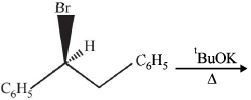
The major product obtained in the following reaction is :