MCQ
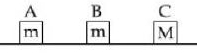
Three blocks $A, B$ and $C$ are lying on a smooth horizontal surface, as shown in the figure. $A$ and $B$ have equal masses, $m$ while $C$ has mass $M$. Block $A$ is given an initial speed $v$ towards $B$ due to which it collides with $B$ perfectly inelastically. The combined mass collides with $C$, also perfectly inelastically. The combined mass collides with $C$, also perfectly inelastically if $\frac{5}{6}^{th}$ of the initial kinetic energy is lost in whole process. What is value of $M/m$ ?
  • A
    $5$
  • B
    $2$
  • $4$
  • D
    $3$

Answer

Correct option: C.
$4$
c
Apply $LMC$ (Linear Momentum Conservation)

$mv = (2m + M) v'$

$v' = \frac{{mv}}{{2m + M}}$

Initial energy 

$\frac{1}{2}$ $m{v^2}$

Final energy 

$\frac{1}{2}\,\left( {2m + M} \right){\left( {\frac{{mv}}{{2m + M}}} \right)^2}$

$Initial\, kinetic\, energy - Final\, Kinetic\, energy =$  $\frac{5}{6}$ of initial kinetic energy.

After solving, we get, $\frac{M}{m} = 4.$

Need a full question paper?

Generate a complete, print-ready paper with questions like this in minutes — across 16+ boards, with answer keys.

Start Generating Free

Similar questions

Three copper blocks of masses M1, M2 and M3kg respectively are brought into thermal contact till they reach equilibrium. Before contact, they were at T1, T2, T3 (T1 > T2 > T3). Assuming there is no heat loss to the surroundings, the equilibrium temprature T is (s is specific heat of copper)
During motion of a planet from perihelion to aphelion the work done by gravitational force of sun on it is ...........
A crystal has a coefficient of expansion $13\times10^{-7}$ in one direction and $231\times10^{-7}$ in every direction at right angles to it. Then the cubical coefficient of expansion is
The $50\,kg$ homogeneous smooth sphere rests on the $30^{\circ}$ incline $A$ and bears against the smooth vertical wall $B$. Calculate the contact forces at $A$ and $B.$
The percentage error in measurement of mass and speed are $3\%$ and $2\%$ then error in kinetic energy will be .......... $\%$
In a simple harmonic motion, when the displacement is one-half the amplitude, what fraction of the total energy is kinetic?
Three different objects of masses ${m_1},{m_2}$ and ${m_3}$ are allowed to fall from rest and from the same point $‘O’$ along three different frictionless paths. The speeds of the three objects, on reaching the ground, will be in the ratio of
An isolated rail car originally moving with speed $v_0$ on a straight, frictionles, level track contains a large amount of sand. $A$ release valve on the bottom of the car malfunctions, and sand begins to pour out straight down relative to the rail car. Is momentum conserved in this process?
If two glass plates have water between them and are separated by very small distance ( see figure), it is very difficult to pull them apart. It is because the water in between forms cylindrical surface on the side that gives rise to lower pressure in the water in comparison to atmosphere. If the radius of the cylindrical surface is $R$ and surface tension of water is $T$ then the pressure in water between the plates is lower by
Two blocks of same mass $(4\ kg)$ are placed according to diagram. Initial velocities of bodies are $4\ m/s$ and $2\ m/s$ and the string is taut. Find the impulse on $4\ kg$ when the string again becomes taut  .......... $N-s$