Question
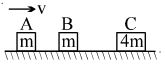
Three blocks are initially placed as shown in the figure. Block $A$ has mass $m$ and initial velocity $v$ to the right. Block $B$ with mass $m$ and block $C$ with mass $4m$ are both initially at rest. Neglect friction. All collisions are elastic. The final velocity of block $A$ is
Answer

since, $A$ and $B$ have same mass. So, after elastic collision, they interchange their velocity

$\therefore \mathrm{v}_{\mathrm{B}}=\mathrm{v}$

After collision between $\mathrm{B}$ and $\mathrm{C}$

$\mathrm{v}_{\mathrm{B}}=\left(\frac{\mathrm{m}-4 \mathrm{m}}{\mathrm{m}+4 \mathrm{m}}\right) \mathrm{v}+\left(\frac{2 \times 4 \mathrm{m} \times 0}{\mathrm{m}+4 \mathrm{m}}\right)=-\frac{3}{5} \mathrm{v}$

Again, collision takes place between $A$ and $B .$ So, velocity will be inter changed.

$\therefore v_{A}=\left(v_{B}\right)=\frac{3}{5} v$

in left ward direction.

Need a full question paper?

Generate a complete, print-ready paper with questions like this in minutes — across 16+ boards, with answer keys.

Start Generating Free

Similar questions

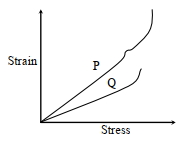
In plotting stress versus strain curves for two materials $P$ and $Q$, a student by mistake puts strain on the $y$-axis and stress on the $x$-axis as shown in the figure. Then the correct statement$(s)$ is(are)

$(A)$ $P$ has more tensile strength than $Q$

$(B)$ $P$ is more ductile than $Q$

$(C)$ $P$ is more brittle than $Q$

$(D)$ The Young's modulus of $P$ is more than that of $Q$

If $\overrightarrow {\rm A} = 2\hat i + 3\hat j - \hat k$ and $\overrightarrow B = - \hat i + 3\hat j + 4\hat k$ a unit vector perpendicular to both $\overrightarrow A $ and $\overrightarrow B $ will be
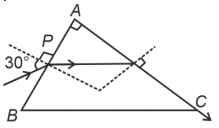
A light ray enters through a right angled prism at point $P$ with the angle of incidence $30^{\circ}$ as shown in figure. It travels through the prism parallel to its base $B C$ and emerges along the face $A C$. The refractive index of the prism is:
Modern vacuum pumps can evacuate a vessel down to a pressure of $4.0 \times {10^{ - 15}}\, atm$ at room temperature $(300\, K)$. Taking $R = 8.0\, JK^{-1}\, mole^{-1}$ , $1\, atm = 10^5\, Pa$ and $N_ {Avogadro} = 6 \times 10^{23}\, mole^{-1}$ , the mean distance between molecules of gas in an evacuated vessel will be of the order of
The sun subtends an angle of $(1/2)^o$ at the surface of the earth. A converging lens of focal length $100\, cm$ is used to obtain an image of the sun on a screen. The diameter of the image formed is about.....$mm$
A particle moves from the point $\left( {2.0\hat i + 4.0\hat j} \right)\,m$, at $t = 0$ with an initial velocity $\left( {5.0\hat i + 4.0\hat j} \right)\,m{s^{ - 1  }}$. It is acted upon by a constant force which produces a constant acceleration $\left( {4.0\hat i + 4.0\hat j} \right)\,m{s^{ - 2}}$. What is the distance of the particle from the origin at time $2\,s$
A coil having an area $2\,{m^2}$ is placed in a magnetic field which changes from $1\,Wb/{m^2}$ to $4\,Wb/{m^2}$ in a interval of $2$ second. The $e.m.f.$ induced in the coil will be......$V$       
A body of mass $M$ tied to a string is lowered at a constant acceleration of $(g/4)$ through a vertical distance $h$. The work done by the string will be..............
A force $\overrightarrow F = - K(y\hat i + x\hat j)$ (where $K$ is a positive constant) acts on a particle moving in the $x-y$ plane. Starting from the origin, the particle is taken along the positive $x-$ axis to the point $(a, 0)$ and then parallel to the $y-$axis to the point $(a, a)$. The total work done by the forces $\overrightarrow F $ on the particle is
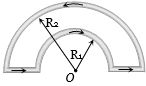
The magnetic induction at the centre $O$ in the figure shown is