MCQ
Three blocks are initially placed as shown in the figure. Block $A$ has mass $m$ and initial velocity $v$ to the right. Block $B$ with mass $m$ and block $C$ with mass $4m$ are both initially at rest. Neglect friction. All collisions are elastic. The final velocity of block $A$ is
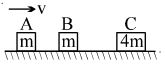
  • $0.6v$ to the left
  • B
    $1.4v$ to the left
  • C
    $v$ to the left
  • D
    $0.4v$ to the right

Answer

Correct option: A.
$0.6v$ to the left
a
since, $A$ and $B$ have same mass. So, after elastic collision, they interchange their velocity

$\therefore \mathrm{v}_{\mathrm{B}}=\mathrm{v}$

After collision between $\mathrm{B}$ and $\mathrm{C}$

$\mathrm{v}_{\mathrm{B}}=\left(\frac{\mathrm{m}-4 \mathrm{m}}{\mathrm{m}+4 \mathrm{m}}\right) \mathrm{v}+\left(\frac{2 \times 4 \mathrm{m} \times 0}{\mathrm{m}+4 \mathrm{m}}\right)=-\frac{3}{5} \mathrm{v}$

Again, collision takes place between $A$ and $B .$ So, velocity will be inter changed.

$\therefore v_{A}=\left(v_{B}\right)=\frac{3}{5} v$

in left ward direction.

Need a full question paper?

Generate a complete, print-ready paper with questions like this in minutes — across 16+ boards, with answer keys.

Start Generating Free

Similar questions

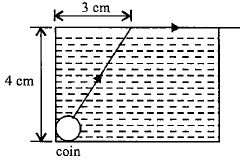
A small coin is resting on the bottom of a beaker filled with liquid. A ray of light from the coin travels upto the surface of the liquid and moves along its surface. How fast is the light travelling in the liquid? 
In a potentiometer experiment the balancing with a cell is at length $240\,cm$ . On shunting the cell with a resistance of $2\,\Omega $ , the balancing length becomes $120\, cm$ . The internal resistance of the cell is ................... $\Omega$
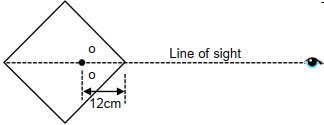
A large square container with thin transparent vertical walls and filled with water (refractive index $\frac{4}{3}$ ) is kept on a horizontal table. A student holds a thin straight wire vertically inside the water $12 cm$ from one of its corners, as shown schematically in the figure. Looking at the wire from this corner, another student sees two images of the wire, located symmetrically on each side of the line of sight as shown. The separation (in $cm$ ) between these images is . . . . . 
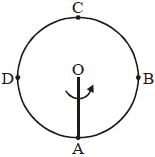
A particle tied to one end of a string is being rotated in a vertical circle with constant frequency. The tension in the string at points $A, B, C$ and $D$ are $T_1, T_2, T_3$ and $T_4$ respectively Then
In an amplifier the load resistance ${R_L}$ is equal to the plate resistance $({r_p})$. The voltage amplification is equal to
A particle of mass $m$ and carrying charge $-q_1$ is moving around a charge $+q_2$ along a circular path of radius r. Find period of revolution of the charge $-q_1$
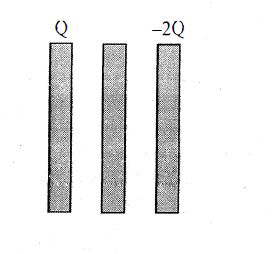
The identical metal plates with large surface areas are kept parallel to each other as shown in figure. The left most plate is given a charge $Q$ , the rightmost a charge $-2Q$ and the middle one remains neutral. Find the charge appearing on the outer surface of the rightmost plate
Three rods of identical area of cross-section and made from the same metal form the sides of an isosceles triangle $ABC$, right angled at $B$. The points $A$ and $B$ are maintained at temperatures $T$ and $\sqrt 2 T$ respectively. In the steady state the temperature of the point C is ${T_C}$. Assuming that only heat conduction takes place, $\frac{{{T_C}}}{T}$ is equal to
Lines which represent places of constant angle of dip are called
A ball $P$  collides with another identical ball  $Q$  at rest. For what value of coefficient of restitution $e$ , the  velocity of ball  $Q$  become two times that of ball  $P$  after collision