MCQ
Three containers $\mathrm{C}_{1}, \mathrm{C}_{2}$ and $\mathrm{C}_{3}$ have water at different temperatures. The table below shows the final temperature $T$ when different amounts of water (given in litres) are taken from each containers and mixed (assume no loss of heat during the process)

$\begin{array}{|c|c|c|c|}\hline \mathrm{C_{1 }} & {\mathrm{C}_{2}} & {\mathrm{C}_{3}} & {\mathrm{T}} \\ \hline {1 l} & {2 l} & {-} & {60^{\circ} \mathrm{C}} \\ \hline {-} & {1 l} & {2 l} & {30^{\circ} \mathrm{C}} \\ \hline  {2 l} & {-} & {1 l} & {60^{\circ} \mathrm{C}} \\ \hline  {1 l} & {1 l} & {1 l} & {\theta} \\ \hline\end{array}$

The value of $\theta$ (in $^{\circ} \mathrm{C}$ to the nearest integer) is

  • A
    $45$
  • B
    $48$
  • C
    $55$
  • $50$

Answer

Correct option: D.
$50$
d
According to table and applying law of calorimetry

$1 \mathrm{T}_{1}+2 \mathrm{T}_{2}=(1+2) 60^{\circ}$

$=180$

$1 \mathrm{T}_{2}+2 \mathrm{T}_{3}=(1+2) 30^{\circ}$

$=90$

$2 \mathrm{T}_{1}+1 \mathrm{T}_{3}=(1+2) 60$

$=180$

$3\left(\mathrm{T}_{1}+\mathrm{T}_{2}+\mathrm{T}_{3}\right)=450$

$\mathrm{T}_{1}+\mathrm{T}_{2}+\mathrm{T}_{3}=150^{\circ}$

Hence,

$\mathrm{T}_{1}+\mathrm{T}_{2}+\mathrm{T}_{3}=(1+1+1) \theta$

$150=3 \theta$

$\theta=50^{\circ} \mathrm{C}$

Need a full question paper?

Generate a complete, print-ready paper with questions like this in minutes — across 16+ boards, with answer keys.

Start Generating Free

Similar questions

If the distance of the earth from Sun is $1.5 \times 10^6\,km$. Then the distance of an imaginary planet from Sun, if its period of revolution is $2.83$ years is $.............\times 10^6\,km$
A machine gun fires a bullet of mass $40\,g$ with a velocity $1200\,\,m{s^{ - 1}}.$ The man holding it can exert a maximum force of $144\,N$ on the gun. How many bullets can he fire per second at the most
Two strings A and B, made of same material, are stretched by same tension. The radius of string A is double of the radius of B. A transverse wave travels on A with speed $\nu_\text{A}$ and on B with speed $\nu_\text{B}.$ The ratio $\frac{\nu_\text{A}}{\nu_\text{B}}$ is:

  1. $\frac{1}{2}$

  2. $2$

  3. $\frac{1}{4}$

  4. $4.$

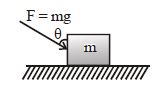
The force acting on the block pushes it, then pushing of the block will be possible along the surface if
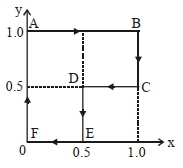
A particle is moved along a path $A B-B C-C D-D E-E F-F A$, as shown in figure, in presence of a force $\overrightarrow{ F }=(\alpha \hat{y}+2 \alpha \hat{x} \hat{j}) N$, where $x$ and $y$ are in meter and $\alpha=-1 N / m ^{-1}$. The work done on the particle by this force $\vec{F}$ will be. . . . . . Joule.
A smooth sphere $A$ of mass $m$ collides elastically with an identical sphere $B$ at rest. The velocity of $A$ before collision is $8\ m/s$ in a direction making $60^o$ with the line of centres at the time of impact.

$(i)$ The sphere $A$ comes to rest after collision.

$(ii)$ The sphere $B$ will move with a speed of $8\ m/s$ after collision.

$(iii)$ The directions of motion $A$ and $B$ after collision are at right angles.

$(iv)$ The speed of $B$ after collision is $4\ m/s$ . The correct option is 

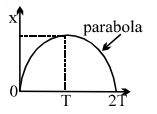
 The $x-t$ graph of a particle moving along a straight line is shown in figure The $v-t$ graph of the particle is correctly shown by
A wire of diameter $1mm$ breaks under a tension of $1000\, N.$ Another wire, of same material as that of the first one, but of diameter $2\, mm$ breaks under a tension of ...... $N$
A steel rod of length $100\, cm$ is clamped at the middle. The frequency of the fundamental mode for the longitudinal vibrations of the rod is ..... $kHz$ (Speed of sound in steel $= 5\, km\, s^{-1}$)
Given that $v$ is speed, $r$ is the radius and $g$ is the acceleration due to gravity. Which of the following is dimensionless