Question
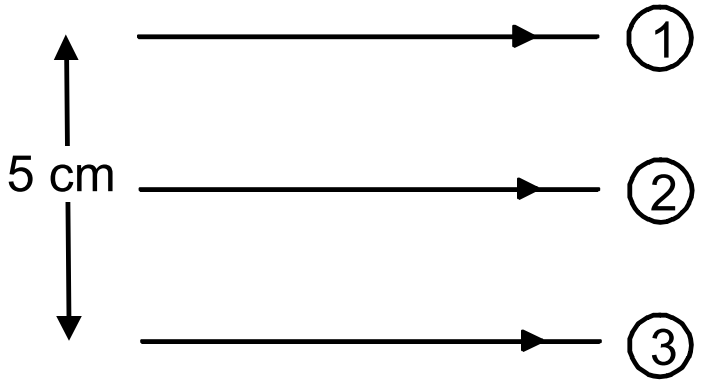
Three coplanar parallel wires, each carrying a current of 10A along the same direction, are placed with a separation 5.0cm between the consecutive ones. Find the matnitude ol the magnetic force per unit lenght acting on the wires.
Answer

i = 10A

Magnetic force due to two parallel Current Carrying wires.
$\text{F}=\frac{\mu_0\text{I}_1\text{I}_2}{2\pi\text{r}}$
So, $\overrightarrow{\text{F}}\ \text{or}\ 1=\overrightarrow{\text{F}}\ \text{or}\ 2+\overrightarrow{\text{F}}\ \text{by}\ 3$
$=\frac{\mu_0\times10\times10}{2\pi\times5\times10^{-2}}+\frac{\mu_0\times10\times10}{2\pi\times10\times10^{-2}}$
$=\frac{4\pi\times10^{-7}\times10\times10}{2\pi\times5\times10^{-2}}+=\frac{4\pi\times10^{-7}\times10\times10}{2\pi\times10\times10^{-2}}$
$=\frac{2\times10^{-3}}{5}+\frac{10^{-3}}{5}=\frac{3\times10^{-3}}{5}=6\times10^{-4}\text{N}$ towards middle wire

Need a full question paper?

Generate a complete, print-ready paper with questions like this in minutes — across 16+ boards, with answer keys.
Start Generating Free

Similar questions

Define the term ‘resolving power’ of an astronomical telescope. How does it get affected on:
  1. Increasing the aperture of the objective lens?
  2. Increasing the wavelength of light used?
  3. Increasing the focal length of the objective lens?
 Justify your answer in each case.
Suppose the loop in Exercise 6.4 is stationary but the current feeding the electromagnet that produces the magnetic field is gradually reduced so that the field decreases from its initial value of 0.3T at the rate of 0.02T s–1. If the cut is joined and the loop has a resistance of 1.6Ω, how much power is dissipated by the loop as heat? What is the source of this power?
  1. Using Biot-Savart’s law, derive the expression for the magnetic field in the vector form at a point on the axis of a circular current loop.
  2. What does a toroid consist of ? Find out the expression for the magnetic field inside a toroid for N turns of the coil having the average radius r and carrying a current I. Show that the magnetic field in the open space inside and exterior to the toroid is zero.
A point object is placed at a distance of 15cm from a convex lens. The image is formed on the other side at a distance of 30cm from the lens. When a concave lens is placed in contact with the convex lens, the image shifts away further by 30cm. Calculate the focal lengths of the two lenses.
A vessel of volume 125cm3 contains tritium $\big(\text{ }^3\text{H,t}_{\frac{1}{2}}=12.3\text{y}\big)$ at 500 kPa and 300K. Calculate the activity of the gas.
238U decays to 206Pb with a half-life of 4.47 × 10⁹y. This happens in a number of steps. Can you justify a single half for this chain of processes? A sample of rock is found to contain 2.00mg of 238U and 0.600mg of 206Pb. Assuming that all the lead has come from uranium, find the life of the rock.
The intensity of the sunlight reaching Earth is 1380Wm-2. Assume this light to be a plane, monochromatic wave. Find the amplitudes of electric and magnetic fields in this wave.
A wave propagates on a string in the positive x-direction at a velocity v. The shape of the string at t = to is given by $\text{g}(\text{x},\text{t}_0)=\text{A}\sin\big(\frac{\text{x}}{\text{a}}\big).$ Write the wave equation for a general time t.
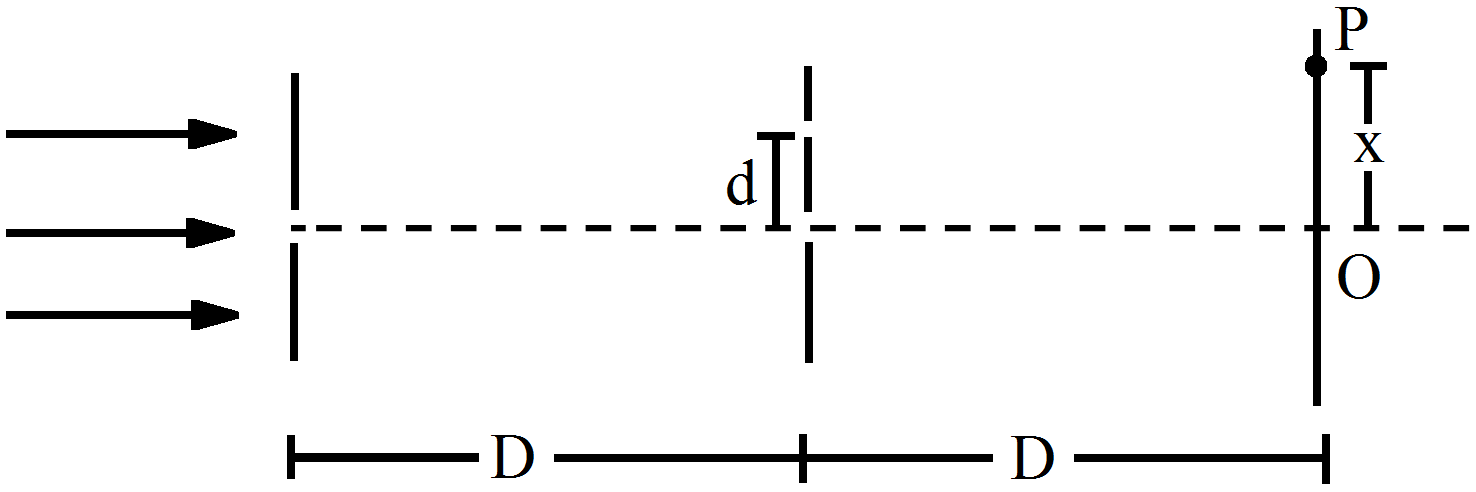
Consider the arrangement shown in figure (17-E4). The distance D is large compared to the separation d between the slits.
  1. Find the minimum value of d so that there is a dark fringe at 0.
  2. Suppose d has this value. Find the distance x at which the next bright fringe is formed.
  3. Find the fringe-width.

A hydrogen atom moving at speed υ collides with another hydrogen atom kept at rest. Find the minimum value of υ for which one of the atoms may get ionized. The mass of a hydrogen atom = 1.67 × 10⁻²⁷kg.